
Girish Ramadurgam on Talent-Fitment” Problem: How to resolve the skill mismatch
Talent fitment isn’t only about external hiring, when a role or a vacancy arises, but also internal, when existing employees are being positioned for new roles. Organizations could earlier compensate for imperfect fitment with larger teams, longer timelines and multi-layer roles. Competence was measured by educational background and some generic skills, which were considered sufficient. What has changed dramatically in the last few years is the advent and adoption of AI, which has transformed expectations.
As AI reshapes enterprise operating models, CHROs are being asked to solve a challenge that sits at the intersection of business performance, workforce strategy, and technology: talent fitment. In an environment defined by compressed delivery cycles, leaner teams, and rapid role evolution, the cost of mismatched talent is no longer confined to hiring inefficiencies—it directly impacts productivity, innovation, and organizational credibility. For HR leaders, the mandate has shifted from filling roles to architecting dynamic talent systems that continuously align capability with context.
This shift requires CHROs to move beyond traditional hiring frameworks anchored in credentials, static job descriptions, and intuition-led assessments. Talent fitment today demands AI-enabled evaluation models that surface real skills, decision-making ability, adaptability, and complementary strengths—often hidden beyond the CV. It also calls for governance-led hiring, where clarity of roles, bias-free assessment, panel capability, and accountability for outcomes are embedded into the talent lifecycle. Technology, when applied responsibly, becomes a force multiplier—bringing objectivity, transparency, and predictability to hiring and internal mobility decisions.
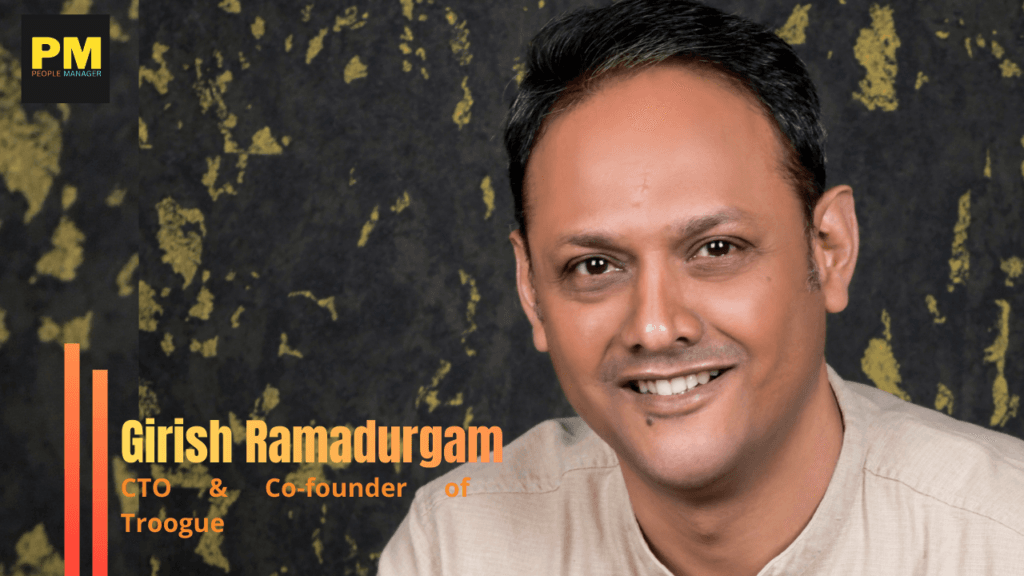
In this conversation with People Manager, Mr. Girish Ramadurgam, CTO and Co-founder of Troogue, outlines how AI and analytics can help HR leaders transition from reactive talent acquisition to proactive talent architecture. He shares insights on why skill mismatches persist despite abundant talent, how continuous assessment and feedback loops can reduce misfit risk, and why upskilling and reskilling must be treated as always-on capabilities rather than episodic initiatives. His perspective reinforces a critical message for CHROs and HR-tech leaders alike: the future of workforce effectiveness will be defined not by how much talent organizations acquire, but by how intelligently they deploy, evolve, and fit that talent to ever-changing business needs.
Q.: Mr. Ramadurgam, how do you define the “talent-fitment” problem in today’s IT sector, and why has it become so critical now?
Ans.: Talent fitment isn’t only about external hiring, when a role or a vacancy arises, but also internal, when existing employees are being positioned for new roles. Organizations could earlier compensate for imperfect fitment with larger teams, longer timelines and multi-layer roles. Competence was measured by educational background and some generic skills, which were considered sufficient. What has changed dramatically in the last few years is the advent and adoption of AI, which has transformed expectations.
Today, the ability to write code or possessing technical knowledge is no longer the primary differentiator. What has changed is that teams are smaller, timelines have gotten compressed and cost of talent misfit is huge. That has led to evolving talent requirements – one that can understand the domain quickly, make the right decision taking AI into consideration and do so independently with minimal supervision.
Q.: In your view, what are the primary drivers of skill mismatches—are they more due to rapid tech evolution, education gaps, or organizational hiring practices?
Ans.: Skill mismatches today stem from rapid technological evolution, structural gaps in education, and outdated hiring practices. But the real issue is how organizations respond to these shifts.
Technology is advancing far faster than education systems can adapt. Formal education continues to prioritise credentials and foundational knowledge, while the industry increasingly demands job-ready, role-specific and context-driven skills, making degrees a weaker indicator of real-world effectiveness.
This gap is often amplified by hiring approaches that rely on static role definitions, even though actual project needs evolve once execution begins. As a result, organizations hire for credentials rather than adaptability, domain understanding, and the ability to work effectively across teams.
The challenge is further compounded by growing noise in the hiring process. With AI-generated resumes, interview assistance, and standardised coding outputs, it has become increasingly difficult to distinguish genuine capability from surface-level signals—on paper, most candidates appear to be a perfect fit. Combined with conflicting stakeholder expectations, this leads to persistent mismatches not due to lack of talent, but because hiring frameworks have failed to keep pace with how work and teams are changing.
Q.: Could you walk us through Troogue’s unique methodology for bridging the gap between available talents and evolving IT skill demands?
Ans.: Troogue is built on empowerment and trust. We first understand what organizations genuinely need from a role, in detail and with specifics instead of generic JDs. Then, expectations need to be aligned with the right talent which is why individuals are evaluated not only on the skills a role demands, but also on complementary experience that can add value to the organization. This helps uncover strengths beyond the job description—such as a developer with customer-facing experience or technical talent with business analysis capabilities. As an example, when scouting for talent for technical roles, instead of long, generic coding tests, we have introduced shorter, focused evaluations. These assess a candidate’s specific skills and knowledge, along with relevant behavioral and communication indicators.
We also provide feedback and mock interviews to help candidates prepare, build confidence, and succeed in real project environments. This approach reduces misfit risk by revealing how a person actually performs, not just what they claim.
For organizations, it enables faster, more confident hiring decisions with higher predictability in outcomes. For candidates, it restores agency and motivation, allowing them to build a credible, evolving profile that reflects their true capabilities.
Q.: How is Troogue leveraging AI, analytics, or digital platforms to identify and resolve mismatches in real time?
Ans.: Troogue uses AI and analytics to bring structure, transparency, and actionable insights to the hiring process. We start by helping organizations refine their job descriptions with clear, role-specific skill requirements. This forces organizations to reassess what is truly critical versus nice-to-have, creating a sharper, more realistic expectation.
Based on these inputs, Troogue generates targeted interview questions from a curated library, evaluating candidates across all technical, functional, and behavioral competencies. Interviews are recorded via our proprietary video/audio platform, which extracts features to assess capability, confidence, EQ, and integrity—helping detect inconsistencies or potential fraud.
A continuous feedback loop gives candidates actionable guidance. Post-interview AI agents highlight strengths, gaps, and improvement areas, while practice interviews and curated learning materials prep them for real project challenges. This ensures candidates showcase genuine ability—not just what’s on their CV—and helps prevent misfits before they arise.
Organizations receive detailed, structured reports summarising performance, highlighting where candidates will be most effective, and flagging complementary skills beyond the JD. This enables faster, more confident hiring decisions, reduces bias, and improves the predictability of outcomes. By mapping required skills to observed capabilities in real time, Troogue bridges the gap between available talent and evolving role demands.
Q.: Do you believe organizations should prioritise upskilling existing employees or reskilling talent pools to meet future IT needs?
Ans.: Upskilling/reskilling has always been necessary. That’s a constant. What has changed or should change is the speed of decision making in order to decide what roles to upskill as it’s an extremely dynamic landscape.
Roles are being constantly reassessed and reshaped, with skills that have been built and invested in for decades becoming obsolete faster. If organizations don’t change, they will keep investing in the wrong skills, which is why upskilling/reskilling needs to be a continuous process rather than just a one-off or occasional thing.
Q.: How does the talent-fitment challenge differ across geographies—for example, India’s IT workforce versus global markets—and how does Troogue adapt its solutions?
Ans.: There is a huge difference. India has a large talent pool which creates its own unique challenge when it comes to seeking quality in hiring since the emphasis is still, to a large extent on, degree and not so much on soft skills which vary widely.
Contrast this to the global scenario where the talent pool is smaller, making it expensive and high cost. The emphasis there is on experience and overall domain expertise rather than just coding. Moreover, there’s a difference in the cost of hiring and decision making.
Despite these differences, the common challenge is assessing real capability—understanding how candidates think, perform, and collaborate beyond what appears on paper. Troogue bridges this gap by mapping verified skills, experience, and strengths to the needs of the role, uncovering potential beyond credentials alone. Our approach eliminates bias, highlights both technical and soft capabilities, and enables truly global, remote-first talent matching.
Q.: Can you share examples of how resolving skill mismatches has directly improved productivity, innovation, or employee engagement in client organizations?
Ans.: Troogue avoids talent mismatch by undertaking a detailed proactive JD analysis, based on which it generates detailed outputs for each candidate. This provides insights of where and how the individual is likely to be most effective.
For instance, a developer hired for a React role was found to also have Node.js and Java experience, plus distributed team exposure and telecom customer interaction—skills that became vital as the project evolved. By surfacing these capabilities upfront, the organization avoided additional hiring, accelerated delivery, increased engagement with enhanced productivity. Similarly, a technical lead’s cloud and architectural expertise, flagged during evaluation, enabled them to stabilise delivery and support multiple teams when unforeseen challenges arose.
By aligning roles to real-world needs and uncovering latent capabilities, Troogue reduces misfit risk, drives productivity, fosters innovation and creates an environment where employees feel empowered and trusted.
Q.: What role should HR leaders and managers play in ensuring talent-fitment, beyond recruitment and training?
Ans.: HR leaders today must go beyond recruitment and training—they need to act as talent architects. They need to offer role clarity to the candidate whilst being careful in panel selection to eliminate any bias. For this, panel-training may also be needed. JDs need to be reworked to ensure they are crisp and clear, rather than being long-winded as they lead to dilution of the job requirements. HR leaders also need to assign accountability around the hiring process and its outcome, offering feedback to fix issues and challenges.
The hiring process also needs to be overhauled by understanding the context of the role and how AI can be applied responsibly to enhance productivity. Hiring decisions should move beyond CVs or degrees, focusing instead on practical ability, judgment, and context understanding. HR must also ensure teams are prepared to integrate new talent and foster engagement, while maintaining accountability for outcomes through feedback and continuous improvement.
Q.: With emerging technologies like generative AI and quantum computing, how do you foresee the talent-fitment problem evolving over the next five years?
Ans.: AI will increasingly play a core role in talent fitment, evolving from AI-assisted evaluation platforms to fully AI-based systems that are standardised, scalable, and adaptive. Talent fitment, in addition to technical competence, will increasingly focus on a candidate’s reasoning ability, decision-making under constraints and trade-off evaluation. Generative AI will also have a significant impact in the evolution of roles, which are already being reshaped due to AI influence as human-AI collaboration models gain wider acceptance within organizations. Since AI platforms will engage in continuous assessment and evaluation of requirements, talent fitment will be a dynamic process rather than being a point-in-time need.
Quantum computing remains niche today, with impact largely limited to research, security, cryptography, and specialised optimisation problems.
Q.: Finally, what practical advice would you give to organizations struggling with skill mismatches today—where should they begin their transformation journey?
Ans.: Firstly, organizations need to adopt AI as a means to directly address persistent fitment challenges and bring greater objectivity, consistency and depth to evaluation.
Secondly, organizations also need to train interview panels to avoid bias or be non- judgmental. Organizations also need to work hard at creating a fear-free environment. Fear-driven assessments distort signals and increase the risk of mismatch.
Talent misfit is not just an external hiring issue—it often exists within organizations themselves. An objective assessment of capabilities against real-world demands rather than legacy assumptions will provide clarity on upskilling, reskilling and role-evolution roadmaps for the future.
Thirdly, clearly define the roles by demarcating the JD into skills that are critical – must-haves – and skills that are desirable, or nice-to-have. This creates a clear communication of expectation from a candidate.
Last but not the least, built-in feedback loops into the hiring or recruitment process by connecting the hiring decisions with performance and future evaluation criteria. Use a possible mismatch as a learning curve and not as a failure since talent fitment is a continuous, dynamic and evolving process.
Key Takeaways for HR Leader
- Redefine talent fitment as a continuous process, not a one-time hiring decision—roles, skills, and expectations must evolve dynamically with business needs.
- Move beyond CVs and credentials by adopting AI-enabled assessments that evaluate real skills, judgment, adaptability, and role context.
- Rework job descriptions to clearly distinguish must-have capabilities from nice-to-have skills, reducing misalignment and hiring noise.
- Strengthen interview panel capability through bias-awareness training and structured evaluation frameworks to improve decision quality.
- Leverage AI responsibly to bring objectivity, consistency, and transparency to hiring—while keeping human judgment and empathy central.
- Build feedback loops between hiring and performance, using early outcomes to refine future talent decisions and role definitions.
- Surface complementary and adjacent skills during evaluations to improve internal mobility, deployment flexibility, and workforce utilization.
- Treat upskilling and reskilling as always-on initiatives, aligned to emerging roles rather than legacy skill investments.
- Create fear-free assessment environments so candidates and employees can demonstrate authentic capability, not rehearsed signals.
- Position HR as a talent architect, accountable not just for hiring speed, but for long-term role success, engagement, and business impact.

- Sagar Pandey on Winning the Talent War in BFSI Recruitment, Retention & Employee Experience - September 9, 2026
- Suvarna Mishra on Redefining the Employee Value Proposition: Making Benefits Truly Reflect How People Live and Work - September 1, 2026
- Three Fourth Solutions Onboards Ishita Shah as Vice President, Global Expansion to Drive International Growth - August 26, 2026







1 thought on “Girish Ramadurgam on Talent-Fitment” Problem: How to resolve the skill mismatch”