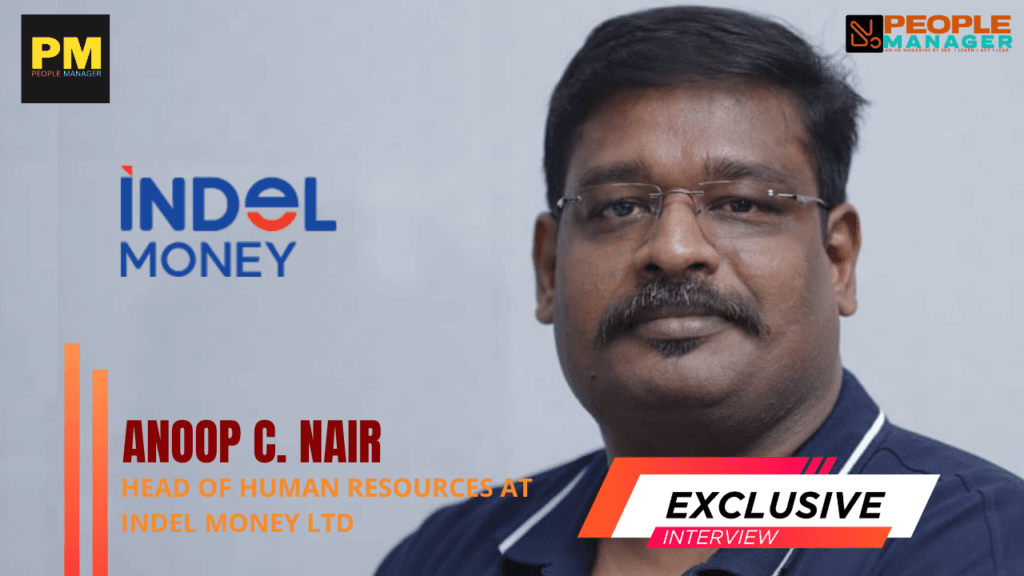
Anoop C. Nair on Flexibility Beyond Remote: How Indel Money Redefines Trust in HR
Managers need to be trained to lead through clear goals, accountability, and influence, rather than physical presence. Organizations (HR) should build capability for inclusive leadership. Managers must be equipped to work across cultures, generations, and work styles.
As financial services evolve under regulatory scrutiny and digital disruption, HR leaders in NBFCs are being asked to solve a challenge that sits at the intersection of compliance, cultural relevance, and workforce adaptability: flexibility. In a sector defined by customer trust, regulatory mandates, and diverse workforce expectations, flexibility is no longer a perk it is a lever for retention, engagement, and organizational resilience. For HR leaders, the mandate has shifted from enforcing uniform policies to architecting people strategies that embed governance while adapting to local realities.
This shift requires HR leaders to move beyond viewing flexibility as remote work alone. In practice, it means micro‑flexibility rotating Saturdays off, role swaps within clusters, and career lattices across functions that align with branch‑heavy, customer‑facing models. It also demands governance mechanisms such as regional councils and policy drift audits to ensure compliance while allowing cultural resonance. Technology, when applied responsibly, becomes a force multiplier handling transactional tasks so managers can focus on reassurance, mentoring, and building trust at the branch level.
In this conversation with People Manager, Anoop C. Nair, Head of Human Resources at Indel Money Ltd, describe how flexibility, when embedded responsibly, transforms HR from policy enforcement to trust architecture. He shares insights on why flexibility must be equitable across demographics, how employee feedback can be treated as a direct input into decision‑making, and why upskilling must be integrated into everyday work rather than episodic interventions. His perspective reinforces a critical message for HR leaders in regulated, customer‑facing industries: the future of workforce effectiveness will be defined not by where employees work, but by how fairly, intelligently, and empathetically organizations design flexibility into governance, leadership behavior, and learning systems.
Q1. Many organizations across regions face different cultural expectations around flexibility. How do you design a people strategy that balances global consistency with local relevance?
Ans: In a gold‑loan NBFC, the core of our people strategy must be consistent—ethical behaviour, RBI compliance, customer dignity, and safety in gold handling. But how we deliver these principles must flex to local realities. Different markets have different customer patterns, festivals, and workforce expectations. We use a framework where the ‘why’ and ‘what’ stay uniform, while the ‘how’ is co‑designed with regional teams. This gives us both compliance strength and cultural resonance.
It’s like Global policy hub + Regional People Councils (zonal heads + HRBP + compliance) that can approve controlled deviations and document rationale. For better givernance, a policy drift” audit can be done to check deviations vs. outcomes.
We standardize the ‘why’ and ‘what,’ and localize the ‘how’—that’s how you stay compliant, humane, and effective.
Q2. With AI and automation reshaping work, how can HR leaders ensure that flexible strategies still prioritize human connection and engagement?
Ans: AI should take over the busywork which are more transactional in nature—never the human work. In our sector, trust is currency, and only people can build that.
AI and automation are fantastic for reducing administrative load—rostering, documentation, reminders. But when you handle gold, which is a metal with emotional connect, trust and empathy are irreplaceable. So our philosophy is ‘high‑tech, high‑touch’: let technology speed up processes, while managers spend more time coaching, engaging, and building branch culture. We design workflows that reserve the critical human moments—customer reassurance, appraiser mentoring, conflict handling—for people, not machines.
Q3. Employees now expect choice in where and how they work. What innovative retention practices have you seen succeed in hybrid or remote-first organizations?
Ans: Flexibility in an NBFC doesn’t always mean working from home. Though we have Work from home options for most of our teams, we are not a fully remote work organisation. For branch-heavy businesses, retention comes from micro-flexibility—rotating Saturdays off, and role swaps within clusters when employees have personal needs. We also focus on career lattices, not just ladders, so employees can move across credit, audit, sales, or training. These practical, on-ground flex models have proven far more sustainable than traditional remote work in a regulated, customer-facing environment.
Flexibility doesn’t always mean remote—it means choice. Even in branch-led models, micro-flexibility has become a powerful retention lever.
Q4. How do you integrate employee feedback into shaping flexible policies, and what mechanisms ensure that voices from diverse geographies are equally heard?
Ans: “For us, feedback isn’t a survey—it’s a decision-making input. All our Leaders including the ED & CEO travel to branches and are very accessible to our people, irrespective of their hierarchy. We conduct regular All staff meetings where all department heads travel and interact with all staff in their respective locations which makes first hand feedbacks reach the top without any transmission loss. We also have regular leader huddles, and regional listening circles with all department leaders, so employees from rural, semi-urban branches and urban branches are equally heard. The key is rapid action: We try to translate feedbacks into policy tweaks at the earliest. This closes the loop, builds trust, and ensures employees see HR as a partner, not a distant corporate team.” The recent changes in Work from Home policy, Recharge Leave and Family leave are all results of such connects with employees.
Q5. Up skilling is critical in the digital era. How can flexible people strategies accelerate reskilling initiatives while keeping employees motivated and engaged?
Ans: In the digital era, reskilling cannot be treated as a one-time intervention — it has to become part of how work is designed. Flexible people strategies play a critical role in making this shift both effective and engaging.
Flexibility allows learning to be embedded into everyday work rather than added on as an extra burden. When employees are given the flexibility to allocate time for learning — through modular schedules, digital platforms, or project-based assignments — upskilling feels achievable instead of overwhelming.
Flexible strategies enable personalised learning journeys. Not everyone needs the same skills or learns in the same way. Some may benefit from short digital modules, others from coaching, stretch assignments, or peer learning.
Linking reskilling to visible career pathways keeps engagement high. When employees can see how new skills connect to future roles, internal mobility, or leadership opportunities, learning becomes purposeful rather than theoretical.
Finally, flexibility creates psychological safety around learning. Employees are more willing to try, fail, and grow when learning is not tied only to immediate performance metrics but seen as an investment in their long-term employability.
In essence, flexible people strategies keep employees motivated by shifting the narrative from “training for today’s job” to “building capability for tomorrow’s career.” Organizations that get this right will not just upskill their workforce — they will build a culture of continuous growth and adaptability.
Q6. What role should leaders play in modelling flexibility, and how can organizations prepare managers to lead distributed, diverse teams effectively?
Ans: Flexibility works only when leaders model it visibly. People don’t follow policies, they follow behaviour. So we expect leaders to show three things: trust, availability, and outcome‑orientation. When a leader plans their week transparently, respects personal time, and manages by outcomes rather than attendance, that culture naturally cascades down to branches.
When leaders model flexibility and managers are trained to lead with empathy and structure, the organization becomes both flexible and high‑performance.”
Managers need to be trained to lead through clear goals, accountability, and influence, rather than physical presence. Organizations should build capability for inclusive leadership. Managers must be equipped to work across cultures, generations, and work styles. This includes developing skills in:
- Bias awareness and inclusive decision-making
- Cross-cultural communication
- Managing different zones, cultures and personal constraints with sensitivity
Organisations must hold leaders accountable for how they lead, not just what they deliver. It must invest in preparing managers to lead with empathy, clarity, and inclusion in a distributed world of work.
Q7. Flexibility can sometimes unintentionally favour certain groups. How do you ensure equitable access to opportunities and career growth across all employee demographics?
Ans: In a branch-led NBFC environment, fairness in flexibility has to be designed into the system — it cannot be left to intent or individual discretion.
We begin by clearly mapping each role to identify what must be physically on-site and what aspects of work can be flexible. This role-based framework removes managerial subjectivity and ensures consistency across locations.
We track patterns. Any imbalance beyond a tolerance level prompts a review and corrective action. For career progression, we use skills-based and outcome-driven assessments for all roles. The roles are open to all who shows the spark and are locationally mobile. If his track record in the current role also proves his potential, there is nothing stopping his / her progression in the system. This ensures that growth opportunities are linked to capability and performance rather than visibility, proximity to headquarters, or informal networks.
By making flexibility measurable and skills-driven, we ensure it becomes a leveller—not an accidental advantage for a few.
Q8. Beyond turnover rates, what new metrics or indicators should HR leaders track to measure the success of flexible people strategies in retaining talent?
Ans: We should go beyond attrition and track metrics that show real organizational health—audit exceptions, time‑to‑competence for new hires, customer happiness scores , and internal mobility. When these indicators improve alongside engagement scores, we know our flexibility strategy is working. In a high-compliance business like ours, a flexible workplace must still enhance risk discipline, and these metrics keep us honest.
Q9. Could you share an example where a flexible people strategy significantly improved engagement or retention in a multinational setting?
Ans: The thought process behind our people strategy is that flexibility is not just about where people work — it is about how work, careers, and life are designed together. We had brought in Work from home, Recharge Leaves and Family leaves for our employees which is not so common in NBFCs especially the ones in our space, at the moment. Our strategies / policies are designed keeping that in mind and we have already started seeing the positivity among the workforce in a short span of time. Our people are experiencing work in a different and positive way which they have not experienced in their previous organisations / competitors. This feedback has come through various channels from our people. We intend to keep ourselves an organisation which is flexible enough to change, in tandem with the changing needs of an emerging workforce of a fast evolving India Inc.
Q10. As digital work evolves, what bold shifts do you foresee in HR practices over the next five years, and how should organizations prepare today?
Ans: The next wave of HR in NBFCs will focus on skills over roles, digital learning integrated into daily workflows, and data-driven decisions that predict attrition and risk. Leaders will spend far more time coaching than controlling, and wellbeing will become a business risk indicator. Technology will automate routine work, but human judgment, trust-building, and community connection will define success.
Employee experience will be a strategic priority. As hybrid and digital work expand, HR will focus on designing meaningful, flexible, and inclusive work environments that balance productivity with wellbeing and engagement
Organisations should invest in digital HR platforms and analytics, adopt a skills-based workforce strategy, strengthen learning ecosystems, and upskill HR teams in data literacy, design thinking, and business understanding. Most importantly, they must shift their mindset from managing jobs to enabling talent.
For further insights into the evolving workplace paradigm, visit

- New financial year to reshape salary structures for millions in India - March 26, 2026
- Sammir Inamdar On Agentic AI as a Catalyst for Measurable Learning Transfer - March 26, 2026
- Tony Joseph On How CHRO Build a People-First Workforce at Scale - March 23, 2026