Trade Unions To Go On Strike In Feb, Demand Withdrawal Of Labour Codes
The Joint Platform of Central Trade Unions and Sectoral Federations/Associations met on 8 December 2025 in hybrid mode. The meeting took stock of the situation after the notification of the labour codes: Reports
New Delhi, December 10, 2025 — India’s central trade unions have decided to step up their opposition to the government’s labour codes, announcing a phased programme of action that will culminate in a nationwide general strike in February 2026. The decision follows a meeting of the Joint Platform of Central Trade Unions and Sectoral Federations/Associations held on December 8 in hybrid mode, where leaders assessed the situation after the recent notification of the labour codes.
The unions said the precise date of the general strike would be announced on December 22, after the next meeting of the joint forum. In a statement issued on Tuesday, the platform described the proposed strike as part of a “consistent and determined struggle” to force the withdrawal of the codes, which they argue fundamentally weaken labour protections and significantly strengthen employers’ bargaining power.
At the centre of the confrontation are the four labour codes—on wages, industrial relations, social security, and occupational safety, health and working conditions—passed between 2019 and 2020 by consolidating 29 existing labour laws. The government maintains that the codes modernise India’s labour framework, reduce regulatory complexity, improve compliance, and broaden social security coverage, particularly for unorganised workers.
Trade unions, however, have opposed the reforms from the outset. They contend that the codes dilute hard-won rights, weaken collective bargaining, increase thresholds for retrenchment approvals, and institutionalise contractualisation. The five-year delay in notification, union leaders argue, reflected sustained resistance from workers across sectors. In their statement, unions described the response from the working class as “spontaneous and widespread,” noting participation by non-unionised workers and even sections traditionally aligned with the ruling dispensation, including members of the Bharatiya Mazdoor Sangh.
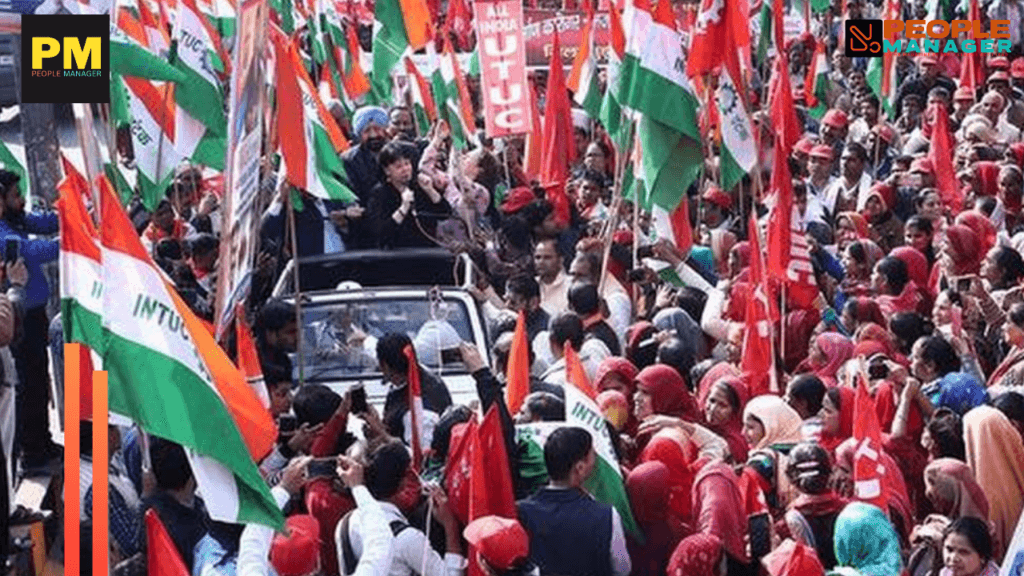
Union leaders pointed to the nationwide protests held on November 26, 2025, as evidence of growing momentum. Demonstrations took place at workplaces, district and block headquarters, and industrial hubs across the country. The protests were also joined by the Samyukta Kisan Morcha (SKM), which linked its opposition to the Seed Bill with resistance to the labour codes, mobilising support in rural areas and villages.
The joint platform accused the government of mounting an “unprecedented propaganda campaign” to portray the codes as worker-friendly, citing mass advertising and sponsored media content. According to the unions, such efforts suggest unease within the administration and among corporate interests facing sustained resistance.
The unions also raised concerns about what they described as growing confusion within labour departments and adjudicatory bodies, arguing that the transition to the new codes has created operational and enforcement ambiguities. They cited recent high-profile industrial disputes and incidents in the aviation sector—referred to in their statement as the “Indigo menace”—as symptomatic of corporate impunity and inadequate regulatory oversight.
According to the unions, these developments vindicate long-standing warnings about unchecked privatisation, monopolisation, and the erosion of worker and passenger safety in strategic sectors.
Under the agreed strategy, state-level units will convene within a week to draw up detailed action plans. These will include mass contact programmes, jathas (marches), rallies, workplace actions, and door-to-door campaigns designed to broaden outreach beyond organised labour. The objective is to build sustained pressure through district and state-level mobilisation before escalating to the nationwide strike.
The platform also plans closer coordination with the SKM and other mass organisations to frame the struggle as a wider resistance to what it terms “anti-people, pro-corporate policies.” Opposition political parties, youth and student groups have been urged to extend solidarity, with unions positioning the agitation as a defence of democratic rights and the social compact underlying India’s labour regime.
While unions remain unequivocally opposed, labour law practitioners have offered more differentiated assessments of specific provisions within the codes.
On wage payments, Gaurav Kumar, Managing Partner at H.L. Kumar & Associates, noted that the requirement to pay wages within two days of cessation of employment strengthens immediate financial security for workers. He also highlighted the expanded wage definition, under which exclusions such as HRA, travel allowance and commissions—if exceeding 50 per cent of total remuneration—must be treated as wages for calculating provident fund, ESI, bonus and gratuity.
Similarly, Yajat Kumar of the Labour Laws Institute pointed to changes benefiting fixed-term employees. Reducing the gratuity eligibility threshold from five years to one year, he argued, corrects long-standing inequities and brings fixed-term workers closer to parity with permanent employees.
These interpretations underscore the complexity of the reforms: while unions see the codes as structurally anti-worker, some provisions are viewed by legal experts as progressive or corrective in isolation.
The impending confrontation unfolds against a backdrop of uneven economic recovery, persistent inflationary pressures and continued employment uncertainty. Trade unions argue that the codes institutionalise precarity by easing hiring-and-firing norms, while the government insists that labour flexibility is essential for investment, competitiveness and job creation.
Politically, the convergence of worker and farmer mobilisation signals a broader challenge to the government’s economic narrative. If opposition parties align openly with the proposed strike, the labour movement could become a central political flashpoint ahead of 2026.
A nationwide strike in February could disrupt manufacturing, transport, banking, and services, echoing the impact of past all-India work stoppages involving millions of workers. Employers may face operational disruptions alongside heightened scrutiny of wage payments, social security compliance and industrial relations practices.
For workers, the mobilisation represents both resistance to perceived dilution of rights and an assertion of collective voice at a time of economic uncertainty. The participation of non-unionised workers suggests that discontent extends well beyond traditional union strongholds.
The announcement of a phased struggle marks a clear escalation in the labour movement’s campaign. With the strike date to be finalised later this month, unions are expected to intensify ground-level engagement and coalition-building in the weeks ahead.
Whether the government responds through dialogue, selective concessions or a firmer push to operationalise the codes remains uncertain. What is clear is that the coming months could prove decisive for the future direction of labour relations and economic policy in India. For further insights into the evolving workplace paradigm, visit

- Raymond Appoints Sarita Tripathi as CHRO for Aerospace and Precision Engineering - March 26, 2026
- Goodyear India Announces Strategic HR Leadership Transition - March 24, 2026
- Supreme Court Urges Law on Paternity Leave in India - March 19, 2026