

Sammir Inamdar On Agentic AI as a Catalyst for Measurable Learning Transfer
Agentic AI also customize the experience based on role, skill level, and performance, so learners get targeted practice that matches their needs. At the same time, the use of AI avatars and multilingual capabilities allows employees to practice in their preferred language and cultural context, making learning more effective.
As organizations accelerate digital transformation and face rapidly evolving skill demands, a persistent challenge continues to undermine workforce effectiveness: the “knowing–doing gap.” Despite significant investments in corporate learning, many organizations struggle to translate knowledge into measurable performance outcomes. This gap is no longer a learning issue alone it is a strategic execution challenge that directly impacts productivity, decision-making quality, and business growth.
At the core of this challenge lies a systemic imbalance between planning and execution. Organizations often equate activity meetings, training sessions, and strategic discussions—with progress. However, without structured mechanisms to enable real-world application, learning remains theoretical. Cultural barriers such as fear of failure, over-engineered processes, and internal competition further inhibit action. The shift required is clear: organizations must move from knowledge accumulation to action-oriented learning ecosystems that prioritize experimentation, agility, and execution discipline.
Agentic AI is emerging as a transformative force in closing this gap by making learning outcomes visible, measurable, and directly linked to business performance. Traditional learning systems focused on completion metrics, offering little insight into actual skill application. In contrast, AI-driven platforms connect learning with real work scenarios, tracking decision-making quality, speed to proficiency, and behavioral improvements. This enables organizations to quantify previously invisible costs of ineffective learning and align capability development with business impact.
A fundamental shift enabled by agentic AI is the transition from delayed application to immediate, experiential learning. Real-time simulations, role-based scenarios, and AI-powered feedback mechanisms eliminate the gap between learning and doing. Employees are no longer passive recipients of knowledge; they actively engage in practice environments that mirror real-world challenges. This not only improves retention but also builds confidence, adaptability, and decision-making capability critical attributes in dynamic business environments.
For global organizations, the challenge extends beyond learning effectiveness to ensuring consistency across geographies, cultures, and languages. AI-driven simulations provide a scalable solution by standardizing core learning experiences while allowing contextual customization. This “standardization with adaptability” ensures that behavioural expectations remain consistent, even as delivery aligns with local nuances. As a result, organizations can drive uniform performance standards without compromising cultural relevance.
The elevation of learning transfer to a board-level priority marks a significant evolution in how organizations evaluate L&D investments. Leaders are now expected to measure outcomes such as revenue impact, customer satisfaction, error reduction, and decision-making efficiency rather than relying on participation metrics. This outcome-driven approach ensures that learning is not an isolated function but a strategic lever for business performance and competitive advantage.
Equally important is the role of AI in exposing shallow learning. Unlike traditional methods that assess knowledge recall, AI-driven simulations evaluate real-time behavior, communication, and decision-making under pressure. This creates a more accurate and objective assessment of capability, enabling organizations to identify true skill gaps and align performance management systems with demonstrated competencies rather than perceived knowledge.
In high-stakes industries, where errors can have significant consequences, AI-powered role-play serves as a risk mitigation tool. By enabling employees to practice complex scenarios in safe, controlled environments, organizations can build preparedness, reduce errors, and enhance confidence before real-world exposure. This proactive approach shifts learning from reactive correction to preventive capability building.
Another critical advantage of agentic AI is its ability to democratize access to high-quality learning. By removing dependencies on physical infrastructure and instructor-led formats, organizations can provide “always-on” practice opportunities to employees across regions, including those with limited training resources. This ensures equity in capability development and supports the creation of a globally consistent talent pool.
Looking ahead, the future of corporate learning will not be defined by the replacement of traditional methods but by the integration of AI into blended learning ecosystems. Foundational knowledge will continue to be delivered through conventional formats, while AI will serve as the execution engine that enables practice, application, and performance tracking. Organizations that successfully integrate these elements will build continuous learning cultures that are agile, data-driven, and outcome-focused.
However, as AI becomes deeply embedded in learning systems, ethical considerations must remain central. Transparency in data usage, psychological safety in practice environments, and cultural sensitivity in AI design are essential to ensure trust and adoption. When implemented responsibly, agentic AI has the potential to redefine learning—not as an event, but as a continuous, immersive, and performance-driven process.
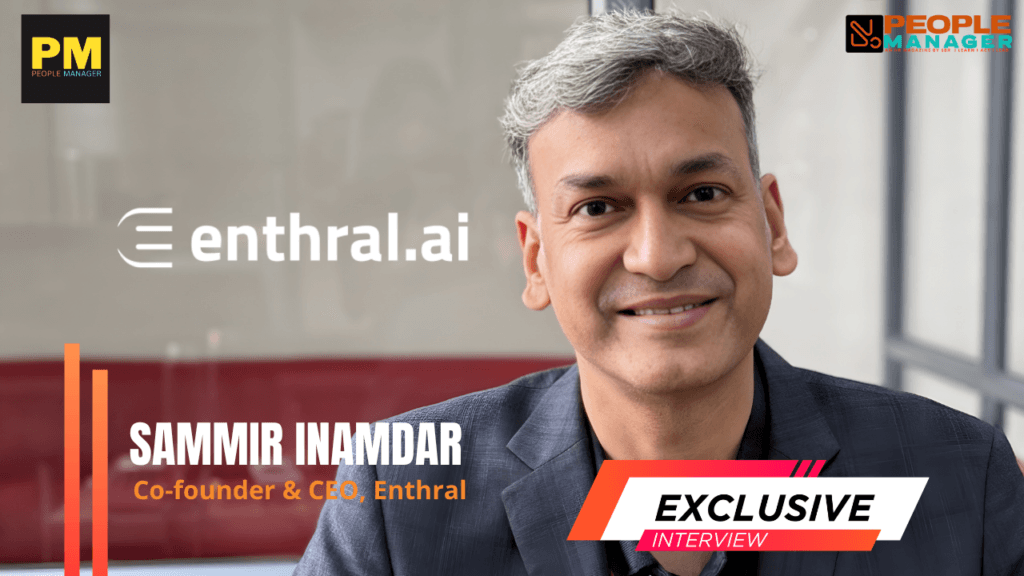
In this conversation with People Manager, Sammir Inamdar, Co-founder & CEO of Enthral.ai, highlights how agentic AI is transforming corporate learning from knowledge delivery to capability activation. His perspective underscores a critical insight for business and HR leaders: the future of workforce performance will not depend on how much employees know, but on how effectively organizations enable them to apply, practice, and continuously refine their skills in real-world contexts.
Q.1 : Many organizations worldwide acknowledge the “knowing–doing gap” in corporate learning. From your perspective, why has this gap persisted across cultures and industries for decades?
Ans: One of the biggest lessons from the “knowing-doing gap” is that most organizations already know what to do, but they struggle to actually do it. The real problem is not lack of knowledge, but lack of action. Research shows that up to 80% of corporate learning fails to translate into improved performance, highlighting that companies often spend more time planning than executing. Many companies spend a lot of time discussing strategies, attending training sessions, and creating plans, but very little time actually implementing them.
Another key issue is that organizations often mistake talking for doing. Meetings, presentations, and decisions create a feeling of progress, but without execution, nothing really changes. Many organizations face cultural barriers like fear, internal competition, and overly complex processes. When employees are afraid to fail or speak up, they tend to avoid taking action. At the same time, too many rules and metrics can slow down decision-making instead of improving it.
The way forward is simple but powerful: focus on action. Encourage learning by doing, create space for experimentation, reduce fear, and keep processes simple. Organizations that act quickly, learn from mistakes, and prioritize execution over perfection are the ones that truly move ahead.
Q.2: You stated that the cost of failed learning transfer was historically invisible. How does agentic AI make these hidden costs measurable and traceable in real business outcomes?
Ans: Earlier, organizations could only track if employees completed training, not whether they actually learned something useful or applied it in their jobs. Because of this, the cost of ineffective learning was never clearly visible. Today, this gap is even more important, as roles are changing very fast. PwC’s 2025 Global AI Jobs Barometer shows that skills in AI-related jobs are changing 66% faster, which means companies need better ways to measure real readiness.
Agentic AI helps solve this problem by connecting learning directly to real work. Instead of just tracking course completion, it shows how people are using their skills, like how quickly they learn, how well they make decisions, and whether they are making fewer mistakes. This helps organizations understand the real impact of training. Enthral.ai’s Roleready.io does exactly this. It helps companies match learning with actual job roles, track how ready employees are, and identify skill gaps that affect performance.
In simple terms, agentic AI makes learning outcomes clear, measurable, and useful for business growth.
Q.3: Traditional L&D often suffers from the delay between learning and application. How does immediate simulation with agentic AI fundamentally change the psychology of learning retention?
Ans: Traditional learning often fails because there is a gap between what people learn and when they actually use it. By the time they apply it, they tend to forget or lose confidence. At Enthral.ai, we use agentic AI to remove this gap through real-time role-play video simulations. Our AI-powered avatars can be fully customized to mimic customers or other stakeholder personas, giving learners a safe, immersive environment to practice and refine their interactions, responses, and decision-making skills. Learners can immediately practice what they’ve learned in situations that feel close to real work. With Role Ready, learners don’t just learn; they experience conversations, handle pushback, and make decisions in real time. The platform enables “on-the-job learning,” so teams can practice anytime without waiting for trainers.
It also goes beyond scripted learning, helping people think on their feet. With real-time feedback on tone, clarity, and confidence, learning becomes action-oriented, improving retention, confidence, and real-world performance.
Q.4: In global corporations with diverse workforces, how can AI-driven simulations ensure consistent behavioral change across geographies, languages, and cultural contexts?
Ans: In global organizations, the real challenge is not just training people, but ensuring consistent behavior across geographies, languages, and cultures. At Enthral.ai, we address this through AI-driven simulations that combine scale, consistency, and real-world relevance, while delivering the personalized experience of 1:1 coaching, something difficult to achieve with human coaches. This approach is especially effective in high-stakes, customer-facing scenarios such as sales, customer success, and support functions, where every conversation can directly influence business outcomes. By combining scale, consistency, and real-world relevance, we help organizations build confident, skilled teams ready to handle complex interactions with impact.
With our RoleReady.io platform, organizations can deliver standardized, role-based training experiences across large and geographically dispersed teams. For example, our work with leading an insurance provider has enabled over 40,000 role plays, helping frontline teams practice real customer interactions through AI-powered simulations. This ensures that every employee is exposed to the same quality of training, regardless of location.
The platform uses AI avatars, two-way video interactions, and real-time feedback to make learning immersive and contextually relevant. Employees can practice conversations, decision-making, and responses in a safe environment, while organizations benefit from objective assessments and consistent evaluation standards.
What makes this powerful is the combination of “always-on” practice and data-driven insights. Leaders get visibility into role readiness across teams, helping them identify gaps and drive targeted interventions.
By combining standardization with adaptability and real-time feedback, AI-driven simulations help organizations drive consistent, measurable behavioral change at scale.
Q.5: You describe learning transfer as becoming a board-level issue. What metrics or evidence should executives now demand to validate ROI from L&D investments?
Ans: As learning transfer becomes a board-level issue, executives should focus on metrics that directly link L&D investments to business outcomes rather than just course completion.
For sales teams, this could include measurable improvements in win rates, deal closures, or conversion rates after employees have applied training in objection handling, negotiation, and persuasion techniques. For customer success teams, relevant indicators might be higher CSAT scores, improved customer retention, or increased referrals that result from effectively applied relationship and support skills.
Apart from these role-specific metrics, organizations can also measure time to proficiency, reduction in errors, speed in decision-making, and improvement in behaviors in real-world situations. The key is to measure whether learning is being applied in real-world situations and whether it is yielding business results.
By focusing on these outcome-oriented metrics, executives can validate the ROI of L&D initiatives in a way that reflects real impact on both performance and organizational goals.
Q.6: How does agentic AI expose shallow learning in ways that traditional classroom or e-learning modules cannot, and what implications does this have for performance management globally?
Ans: AI-driven simulations ensure consistent behavioral change by focusing on how people actually act, not just what they learn. In global organizations, the challenge is not access to training but consistency in how skills are applied across different regions, languages, and cultures.
Simulations solve this by creating realistic, role-based scenarios where every learner practices the same core situations, but in a way that feels locally relevant. AI avatars can adapt language, tone, and cultural nuances while still maintaining a standard framework of what “good performance” looks like. This ensures that while the experience feels customized, the outcomes remain aligned.
More importantly, these simulations are dynamic, not scripted. Learners have to think, respond, and handle real-time challenges, which drives deeper behavioral change compared to static learning.
They also provide consistent feedback on aspects like communication, decision-making, and confidence, creating a shared benchmark across teams globally. For organizations, this means training is no longer dependent on location or facilitator quality. Instead, it becomes scalable, measurable, and aligned to real performance ensuring consistency not just in learning, but in behavior at scale.
Q.7: In industries like healthcare, aviation, or finance, mistakes can be costly. How does AI-powered role-play reduce risk by preparing employees before they face real-world high-stakes scenarios?
Ans: In high-stakes industries like healthcare, aviation, and finance, the cost of mistakes is extremely high, which is why preparation before real-world exposure is critical. AI-powered role-play helps reduce this risk by allowing employees to practice in realistic, pressure-driven scenarios without any real-world consequences.
Through simulations, employees can handle complex situations such as critical patient interactions, emergency responses, or high-value financial decisions in a safe and controlled environment. This helps them build confidence, improve decision-making, and understand the impact of their actions before they face similar situations in reality.
What makes AI role-play especially effective is real-time feedback. Employees receive insights on their responses, communication, and decision-making, helping them correct mistakes instantly and learn faster. They can also repeat scenarios multiple times, which reinforces learning and builds muscle memory.
Additionally, these simulations can be tailored to different risk levels, allowing organizations to prepare employees for both routine and high-pressure situations. By turning learning into hands-on practice, AI-powered role-play ensures employees are better prepared, more confident, and less likely to make costly errors when it matters most.
Q.8 : With global workforces, how can agentic AI democratize access to high-quality practice opportunities, especially in regions where traditional training infrastructure is limited?
Ans: In global organizations, access to high-quality training is often uneven, especially in regions where infrastructure, trainers, or resources are limited. At Enthral.ai, agentic AI helps bridge this gap by making practice accessible, scalable, and consistent for everyone. With platforms like RoleReady.io, employees can engage in real-world simulations anytime, from anywhere, without depending on physical classrooms or instructor-led sessions. This “always-on” access ensures that even teams in remote or underserved regions get the same quality of practice as those in larger hubs.
Agentic AI also customize the experience based on role, skill level, and performance, so learners get targeted practice that matches their needs. At the same time, the use of AI avatars and multilingual capabilities allows employees to practice in their preferred language and cultural context, making learning more effective.
Importantly, every learner receives the same standardized scenarios and objective feedback, ensuring consistency in skill development across locations. By removing barriers of location, cost, and access to trainers, agentic AI democratizes learning giving every employee the opportunity to practice, improve, and perform with confidence, regardless of where they are.
Agentic AI enables learning to become accessible to all employees because it enables them to learn and develop their skills without needing specific locations or training costs or trainer access.
Q.9 : Do you see agentic AI replacing traditional training methods, or will it integrate into blended learning ecosystems? How should global organizations prepare for this transition?
Ans: We don’t see agentic AI replacing traditional training. It is about evolving into a more effective, blended learning ecosystem. Classroom sessions and e-learning still play an important role in building foundational knowledge. However, the real gap has always been in application, and that is where agentic AI comes in.
Through real-world simulations and role-based scenarios, it helps learners move from knowing to doing. Instead of relying only on passive learning, organizations can enable continuous, hands-on practice that builds confidence and improves real performance.
For global organizations, the transition should focus on integrating AI into existing L&D frameworks rather than replacing them. This means aligning training content with role-based simulations, enabling always-on practice, and using data to track readiness and performance. It is also important to build a culture where learning is continuous, not event-based. Teams should be encouraged to practice regularly, not just attend sessions.
Ultimately, the future of learning is blended, combining knowledge, practice, and performance insights. Agentic AI acts as the bridge that connects learning directly to real-world outcomes at scale.
Q.10: As AI becomes the “practice partner” for employees worldwide, what safeguards should organizations put in place to ensure ethical use, psychological safety, and cultural sensitivity?
Ans: As AI becomes a “practice partner” for employees, organizations need to put the right safeguards in place to ensure it is used responsibly and effectively. First, transparency is key. Employees should clearly understand how the AI works, what data is being captured, and how their performance is being evaluated.
Psychological safety is equally important. AI-driven practice environments should be designed as safe spaces where employees can make mistakes, learn, and improve without fear of judgment or negative consequences. The focus should be on development, not surveillance.
Cultural sensitivity is another critical factor, especially in global organizations. AI systems must be trained to recognize different communication styles, languages, and cultural contexts to avoid bias or misinterpretation. Localization should be built into the design, not treated as an afterthought.
Organizations should also ensure strong data privacy and security standards, with clear policies on how learner data is stored and used. Ultimately, the goal is to use AI as an enabler of growth. When designed with transparency, fairness, and empathy, AI can create a supportive learning environment that builds confidence while respecting diversity and individual differences. For further insights into the evolving workplace paradigm, visit

- BDR Pharmaceuticals Appoints Niral Bhatt as Chief Human Resources Officer - September 26, 2026
- The AI Inclusion Challenge: Can Technology Make the Workplace More Inclusive? - September 22, 2026
- How Superworks is Helping CHROs Navigate India’s HR Digitization Shift - September 21, 2026