

The HRBP Identity Crisis: Why Business Problems Need Business-First HR
Organizations increasingly expect HR Business Partners to influence strategic decisions, yet many still approach organizational challenges through an HR lens rather than a business one. Drawing on frontline HRBP experience, this article argues that the next evolution of the role requires a Business-First mindset and introduces the Business-First Diagnostic Model a practical framework for creating greater organizational value.
The HR Business Partner (HRBP) role exists to put HR inside the room where business decisions get made. When Dave Ulrich introduced his HR operating model in the late 1990s, he pushed HR out of a purely administrative function and into something closer to a strategic contributor a partner expected to help create business value, not just process it. The mandate that came with the role was simple to state and harder to live up to: align people strategy with business strategy.
Over the two decades since, organisations built out HRBP structures inside business units and invested heavily in strategic HR capability. Ulrich later pushed the thinking further with his Outside-In HR philosophy the idea that HR creates value when it starts from customers, markets, and business strategy, rather than internal processes looking for a home. The implication hasn’t changed: an HR Business Partner needs to understand the business before reaching for a people solution.
That expectation keeps growing. Deloitte’s 2024 Global Human Capital Trends report argues organisations should stop measuring HR activity and start measuring human performance instead the point where organisational results and human outcomes reinforce each other rather than sitting in separate columns of a report.
And yet, in practice, a familiar paradox keeps showing up. A business leader raises a real business problem productivity sliding, attrition creeping up, project delivery slipping, a team that can’t seem to scale and what comes back is an HR answer: an engagement survey, a learning programme, a recognition initiative, a policy tweak.
Those responses aren’t wrong, exactly. The more useful question is whether they solve the actual problem, or just treat its most visible, most people-shaped symptom. Which raises something less comfortable: have HR Business Partners genuinely become strategic partners to the business, or have we simply gotten very good at solving HR problems that are downstream of something bigger? The answer probably decides whether the role keeps evolving into a real strategic seat or settles into a more sophisticated version of HR support.
The Identity Crisis
The HRBP role has changed enormously over twenty-odd years. The mindset needed to do it well hasn’t always kept up. Organisations now expect HR Business Partners to shape business decisions, build leadership capability, and help the business compete through its people, while many of us still measure our own success by how well the HR execution went. That’s not a skills problem. It’s a mindset one.
HRBPs today are more capable, functionally, than any generation before them. What’s missing isn’t expertise it’s the discipline of diagnosing the organisational problem before reaching for a people solution to fix it. Peter Drucker put it bluntly: there is nothing so useless as doing efficiently that which should not be done at all. An initiative can be beautifully designed and flawlessly delivered and still miss, if it was solving the wrong problem to begin with. That gap is really the difference between being an HR expert and being trusted as a business partner.
I think about this every quarter when I do my rounds. My patch runs from Leh in the north to the far end of Arunachal Pradesh in the northeast, and the two places don’t look anything alike on a dashboard. An engagement score can tell you something’s wrong. It won’t tell you whether the real cause is a manager stretched too thin, a role nobody explained properly, or a business decision made three levels up that never got translated into what it meant for the people underneath it. Most of the time, you only find that out by showing up.
The future relevance of the HR Business Partner role will depend not on how many HR initiatives we deliver, but on the organizational value we help leaders create through people.
So, the identity crisis isn’t really about whether HRBPs should be strategic, that argument was settled years ago. It’s about whether we instinctively reach for an HR lens or a business one when a problem lands on our desk, and why so many capable people still default to the former.
Why This Happens
The gap is rarely about capability. It’s about how HR people are built, and what gets rewarded along the way. Most HRBPs come up through functional disciplines talent acquisition, employee relations, compensation, compliance which builds real expertise but not necessarily commercial instinct. Ulrich’s outside-in idea asks HR to start from the business and work inward. Most of us were trained to do the opposite.
Organisations reinforce this by what they measure. Hiring timelines, engagement, attrition are useful indicators, but they don’t answer the question that matters: did the work move the business? What gets measured gets improved. Evaluate an HRBP purely on how efficiently HR runs, and you get someone excellent at running HR. Evaluate them on the value they create for the business, and the conversation shifts from “which HR initiative should we roll out” to “what’s actually broken here, and what can people strategy do about it?”
A good example from my own patch: we kept losing strong people, and the early instinct mine included was to reach for retention levers. Reward, recognition, another engagement pulse. What the deeper conversations surfaced was quieter than that. People couldn’t see where they were headed. Career paths existed on paper but weren’t visible in practice, so ambitious people left to find clarity elsewhere rather than sit with uncertainty here. We rebuilt how career readiness and growth visibility got discussed structured talent reviews, real conversations between managers and their people about what growth actually required, not just a rating once a year. Retention moved, and so did how people talked about their own future at the company. Neither happened because we ran another survey.
The Business-First Diagnostic Model
If the identity crisis comes from defaulting to an HR lens, the fix isn’t to throw out HR expertise. It’s to change the order in which we think. Business-first partnering doesn’t start with an HR solution. It starts with understanding the problem the business is trying to solve, and only moves toward leadership, capability, or HR intervention once that’s clear.
Every organisational challenge has people implications. Not every people challenge is fundamentally an HR problem. The job of an effective HR Business Partner is to know the difference before recommending anything.
That’s the idea behind the Business-First Diagnostic Model five questions worth working through before any people intervention gets proposed.
- What organisational outcome is being affected? Start with the desired outcome, not the HR metric productivity, customer experience, project delivery, profitability, or growth.
- What evidence supports the diagnosis? Separate assumption from evidence using operational data, workforce insight, and stakeholder perspective.
- What is creating the challenge? Distinguish symptoms from root causes. Attrition, disengagement, and capability gaps are often indicators of deeper leadership or structural issues.
- Which people factors genuinely influence the outcome? Not every organisational challenge requires an HR intervention. Work out where leadership, capability, or culture can meaningfully improve results.
- How will success be measured? Success should ultimately show up in organisational performance not simply in the delivery of an HR initiative.
Figure 1. The Business-First Diagnostic Model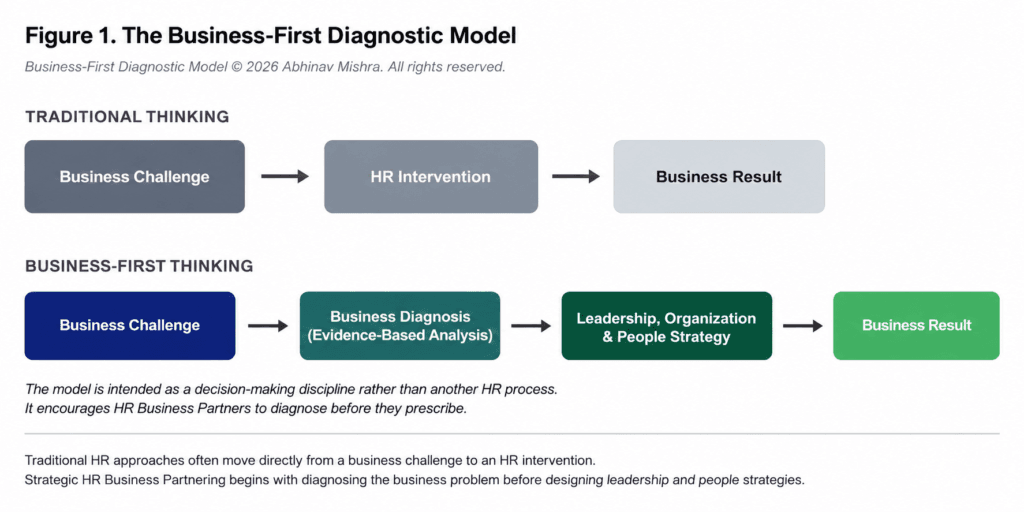
Business-First Diagnostic Model © 2026 Abhinav Mishra. All rights reserved.
TRADITIONAL THINKING
Business Challenge → HR Intervention → Business Result
BUSINESS-FIRST THINKING
Business Challenge → Business Diagnosis → Leadership & People Strategy → Business Result
Traditional HR approaches often move directly from a business challenge to an HR intervention. The Business-First Diagnostic Model introduces a disciplined diagnostic stage.
None of this is meant to replace Ulrich’s thinking, or root-cause analysis, or the judgement HRBPs already bring to the table. What it adds is a habit: a fixed sequence of questions, applied every time, so that starting with the business becomes routine rather than something we only remember to do once a big problem forces our hand.
Strategic business partnering does not begin with an HR solution. It begins with understanding the problem the business is trying to solve.
One more question is worth asking once the five are done, and it might be the sharpest one: would I recommend this if I were accountable for the business outcome, not just the HR outcome? It’s a useful gut check it holds a people recommendation to the same bar a leader would hold a pricing call or a resourcing decision.
Ultimately, an HR Business Partner isn’t meant to have an answer for every people challenge. The job is to ask better business questions before proposing people solutions.
What Effective HR Business Partners Do Differently
A framework only matters if it changes behaviour. The real difference between traditional and business-first HRBPs rarely shows up in a job title it shows up in the questions asked and the decisions actually influenced. Most of the time, effective HRBPs aren’t doing different work from their peers. They’re doing the same work, starting from a different place.
Traditional Approach | Business-First Approach |
Starts with the HR issue. | Starts with the organisational objective. |
Responds to symptoms. | Diagnoses root causes before proposing solutions. |
Measures HR activity. | Measures organisational value enabled through people. |
Recommends HR programmes. | Recommends business solutions supported by people strategy. |
Focuses on HR processes. | Focuses on organisational capability and business performance. |
Reports HR metrics. | Connects people metrics to organisational outcomes. |
Recognition is a good test case. The traditional move, when participation or morale dips, is to widen the reward budget or add another award category. When we looked properly at our own recognition structure, the real issue wasn’t generosity it was visibility and fairness. People didn’t fully trust that recognition was being distributed evenly, so we redesigned how nominations worked and made the process more transparent, rather than simply spending more on it. The lesson generalises: the traditional response and the business-first response can look identical from a distance “fix recognition” and still mean completely different work up close.
This runs deeper than any one initiative. The HRBPs who earn real trust spend less energy promoting HR programmes and more energy improving the quality of business decisions pushing back with evidence, connecting people strategy to what the business is actually trying to do. Their credibility doesn’t come from representing HR. It comes from leaders finding their perspective useful before a decision gets made, not after.
A Different Measure of Success
When Ulrich introduced the HR Business Partner model, he challenged the profession to move beyond administrative excellence and become a strategic contributor to business success. That vision has transformed the role. The next stage of its evolution asks for a different measure of success again.
For years, HRBP effectiveness has been read off the quality of HR delivery: successful talent programmes, stronger engagement, efficient policy execution. These remain worthwhile, but they’re no longer sufficient measures of strategic partnership. The more important question is not how well HR initiatives were delivered, but whether they helped solve an organisational challenge. Business leaders rarely seek HR out because they need another policy or process they seek partners who help them make better decisions and improve organisational performance.
The ambition behind the HRBP role was never simply to bring HR closer to the business. It was to help organisations become stronger through people an ambition that remains as relevant today as when the role was first envisioned.
The future of HR Business Partnering will not belong to those who solve the most HR problems. It will belong to those who help organizations solve their most important challenges through people.
When leaders bring me their hardest problems, I want the answer to be that they see a business partner not an HR expert waiting with a programme. That’s the bar I try to hold myself to, and I think it’s the bar the profession needs to hold itself to as well. For further insights into the evolving workplace paradigm, visit
The ideas and examples presented in this article are the author’s own and are intended to contribute to ongoing conversations on the evolution of strategic HR Business Partnering.
This article is authored by Mr. Abhinav Mishra, an Regional HR Business Partner covering a workforce spread across North, East, and Northeast India, from client sites to remote teams to head office. His work centres on career transparency, employee trust, and connecting HR practice to business outcomes. He was recognised with the HRAI HR Rising Star Award 2026 (Diamond Category) for human-centric HR transformation across distributed workforce ecosystems.

- DR. KOMAL BHANGU ON THE ENERGY CRISIS AT WORK: Why Employee Well-Being Begins with the Everyday Work? - October 1, 2026
- BDR Pharmaceuticals Appoints Niral Bhatt as Chief Human Resources Officer - September 26, 2026
- The AI Inclusion Challenge: Can Technology Make the Workplace More Inclusive? - September 22, 2026






Very detailed perspective on human aspects of the HR and how it helps in becoming the true business partners! Good read!