
Gujarat Assembly passes Factories Amendment Bill to raise 12 hours work shift
In a significant provision, the Bill permits women to work in factories between 7 pm and 6 am, subject to 16 stringent conditions, including the requirement of their written consent.
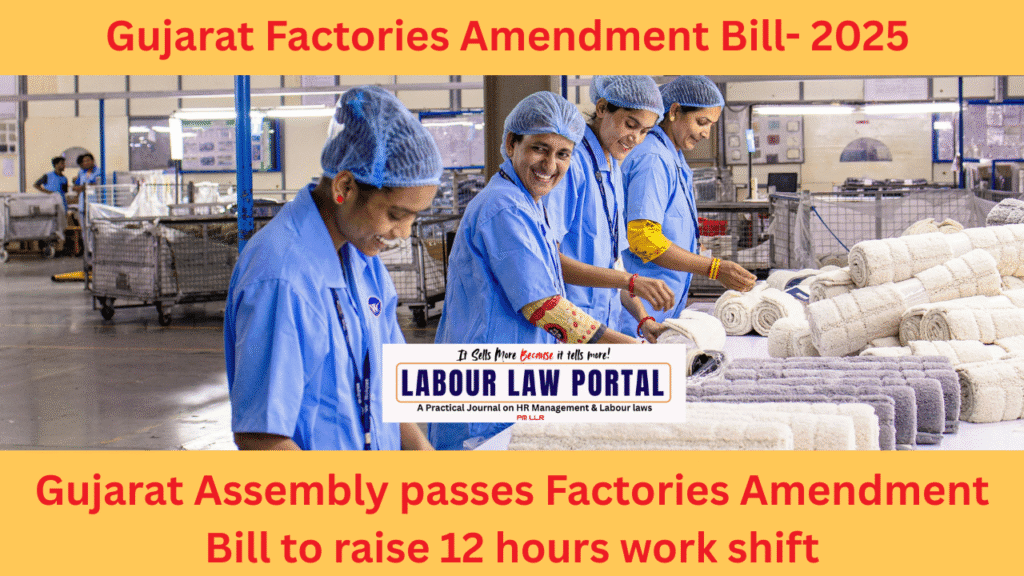
Gandhinagar: The Gujarat Assembly on Wednesday approved the Factories (Gujarat Amendment) Bill, 2025, paving the way for longer daily work shifts of up to 12 hours, while retaining the statutory weekly cap of 48 hours.
The move, introduced by the BJP-led state government, seeks to replace an ordinance promulgated in July this year. Under the new law, workers will be able to complete their weekly quota of 48 hours in four days and avail two paid days off in the same week.
The amendment also mandates that such work arrangements can only be introduced with the written consent of the worker. Employers must pay overtime at twice the ordinary wage rate, and the permissible overtime limit has been raised from 75 to 125 hours per quarter.
In a significant provision, the Bill permits women to work in factories between 7 pm and 6 am, subject to 16 stringent conditions, including the requirement of their written consent.
Legal and Constitutional Context
Labour falls under the Concurrent List of the Constitution, allowing both the Centre and the states to legislate on the subject. India currently has over 100 state-level and 40 central labour laws, governing issues ranging from industrial disputes to wages and working conditions.
The Factories Act, 1948, under which this amendment has been passed, also empowers states to grant exemptions under specific circumstances. Two provisions are commonly invoked:
Section 5: Three-month exemptions in the event of a public emergency (defined as war, external aggression, or internal disturbance threatening national security).
Section 65: Exemptions for factories facing exceptional workloads.
According to a PRS Legislative Research study, at least 12 states—including Assam, Gujarat, Himachal Pradesh, Madhya Pradesh, Odisha, and Uttarakhand—have previously invoked the public emergency clause to extend work hours in factories.
Wider Implications
The Gujarat government has defended the amendment as a step toward flexibility in working arrangements and global competitiveness. However, labour unions are expected to raise concerns around potential exploitation, workplace safety, and the real voluntariness of written consent in employer–employee dynamics.
The development comes amid wider national debates on labour reforms, consolidation of central labour laws into four Labour Codes, and the balance between economic growth and worker protection. For further insights into the evolving workplace paradigm, visit

- India’s White-Collar Hiring Market Climbs 14% in August 2026 : Report - September 9, 2026
- EPFO Urges Employers to Resolve Long-Pending EPF Damages Under VISHWAS 2026 - September 7, 2026
- India to Adopt IST as Sole Legal Reference for HR, workplace and administrative operations from 2027 - September 2, 2026