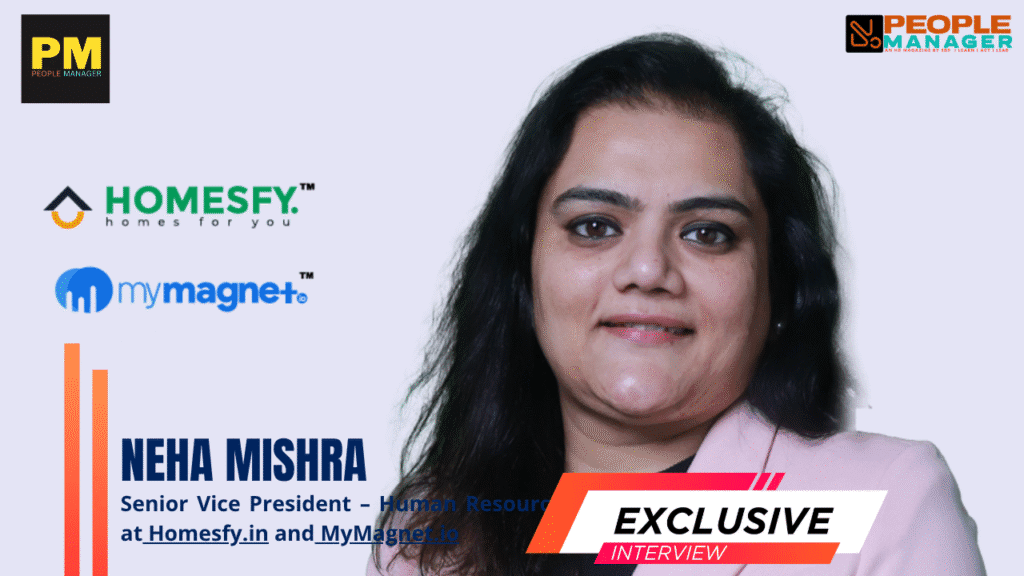
Neha Mishra on Reimagining HR in Real Estate: A People-First, Future-Ready Blueprint
A People-First Approach starts with finding alignment between individuals’ roles and the company’s collective vision. This creates intrinsic motivation for people to invest themselves in achieving the company’s goals and objectives.
PEOPLE MANAGER : How have legacy mindsets in real estate HR systems constrained workforce innovation, and what leadership shifts are essential to drive transformation?
NEHA MISHRA : In today’s, fast-paced real estate environment, traditional HR mindsets often focus heavily on prior experience rather than adaptability, desire, and learning. This can stifle innovation and growth. Talent acquisition needs to move beyond checklists and evaluations, using assessments, and adopt a data-driven mentality that recognises performance, potential, and resilience. It’s time to prioritize those who are agile, hungry for learning, and are willing to disrupt themselves: the capabilities needed for successful digital transformation. It’s clear that HR now has a role to play in strategically designing culture, building leadership, and creating a context in which people feel valued and provided for. With younger talent eager to find purpose, empowerment, and growth, redefining success is paramount to achieving the outcome of empowering the leaders of tomorrow.
PEOPLE MANAGER : With evolving labour laws and rising contractor engagement, how can real estate firms build agile yet compliant HR frameworks that truly scale?
NEHA MISHRA : The reform of labour laws and the consequent increase in contractors is not just a challenge, it’s an opportunity to reimagine and enhance our workforce management. A rigid, traditional mindset often makes it harder to get ahead or even keep pace with rapid regulatory changes and the diverse demands of the workforce. Therefore, we are faced with the need to create agile, tech-savvy, scalable frameworks that are easily adaptable to new change requirements and support multiple engagement models.
As our mindset shifts from change as a disadvantage to change as a possibility, we can grow and sustain HR frameworks that are both legally viable and human-first. In a future world of work where every worker (regardless of permanent or contractor status) feels that they are valued and cared for, we create the preconditions for scalability, future proportionate equity and sustainable opportunities.
PEOPLE MANAGER : What would a people-first approach look like in an industry traditionally focused on land, projects, and profit margins?
NEHA MISHRA : When talking about people-first approach in real estate, it does not mean sacrificing earnings. People are the heart of the company. When people are purposeful and empowered, they bring their best selves to work, positively impacting collective performance, developing innovative ideas, and contributing towards better results.
A People-First Approach starts with finding alignment between individuals’ roles and the company’s collective vision. This creates intrinsic motivation for people to invest themselves in achieving the company’s goals and objectives.
The second pillar of the People-First Approach is trust. When trust serves as a building block of company culture, it unlocks people’s collaboration, capacity to be proactive, and finally, success for all in the endeavor. People are the true profit center for the company. Investing in people leads to improved capacity and capability, resulting in increased efficiency and effectiveness. A people-first approach generates sustainable performance and enhanced well-being for all involved. Additionally, a people-first approach in your organisation is not only the right thing to do, but also the right business move!
PEOPLE MANAGER : Given the differences in urban labour pools, how should real estate HR transform to reflect inclusive talent acquisition and retention?
NEHA MISHRA : Demographic changes have significantly expanded the talent pool, granting access to professionals across sectors and industries. This change presents an opportunity to rethink how organisations attract, engage, and retain talent, incorporating inclusivity into the core conversation. Expanding our movement beyond traditional boundaries creates new opportunities that bring diverse perspectives, new skills, and different ways of working into the workplace. We’ve also begun to prompt a critical examination of the way talent is typically assessed, and we have moved from focusing merely on talent in a conventional way to considering potential, cultural fit, and adaptability.
Retention is high when employees have an emotional connection to the organisation’s mission and consider themselves a part of it. Creating a sense of belonging will help foster deeper engagement with the employee group, as well as a lasting commitment. However, we recognise that one size does not fit all in terms of how we reward and recognise people. We tailor rewards and recognition based on geography, and further to an even smaller group, considering team size dynamics. As examples, what constitutes a “reward” in one program may not be as motivating in another; therefore, we can create events that foster meaning and relevance, making each feel valued, ultimately strengthening a stronger, more inclusive organisation.
PEOPLE MANAGER : As cities become more tech-integrated, what are the future-ready skills HR should prioritize for real estate roles across planning, construction, and customer service?
NEHA MISHRA : As urban centres become increasingly tech-enabled, talent development strategies must move forward. Your HR function must support the transition, turning failures into learning opportunities to help shape the future of work by building talent capacity from the ground up.
Future-ready skills are mandatory. Sales, marketing, and operations roles must be re-equipped with core capabilities such as data management and analytics, digital transformation, and customer-first thinking. It is not merely a case of new tools, but rather a completely new mindset. Mindset is as critical as skillset.
Establishing a collaborative, growth-oriented, innovative and agile culture where failure is viewed as an opportunity is the key to future readiness. Continuous learning is non-negotiable.
When adapting to changes in the competitive environment, the ability to learn, unlearn, and relearn will define success, enabling not only adaptation but also positioning individuals and organisations at the forefront of change with confidence and resilience.
PEOPLE MANAGER : What role does organizational culture play in reducing on-site attrition, conflicts, and project delays, especially in multi-vendor, multi-shift environments?
NEHA MISHRA : A strong, people-focused culture isn’t a wish list item for leaders; it’s the basis for sustainable growth. Mutual respect is not just a value; it’s a daily practice that builds trust. In fast-paced work environments with multiple vendors and shift workers, respect and trust are non-negotiable foundations. Culture is built daily, every day; the ways we connect and support each other; the way we hold each other accountable. When employees feel seen, heard, and valued, the pace of collaboration accelerates, productivity increases, and attrition rates decrease. Respect allows – unravelling distractions, sharpening focus, and providing clarity of outcome. When an organization commits to a people-first philosophy, it creates sustainable, lasting long-term success together.
PEOPLE MANAGER : How can real estate companies balance the rise of HR tech platforms with the need for personalized engagement, especially in blue-collar workforce management?
NEHA MISHRA : Technology is an enabler of productivity; however, it is not technology that can genuinely make a difference. Being able to automate primary HR processes, such as hiring, onboarding, and employee care, enables us to optimise these processes for operational efficiency and allocate time to take a more human approach.
From day one, technology can provide an experience of transparency and engagement in the employee experience.
Some tools enable employees to access payslips, schedules, training, and grievance redressal seamlessly, facilitating stronger engagement with the workplace. Empowerment might not be the best word, but employees now have access to personalised support, even with the use of technology; they feel it is available to them. Digital platforms also provide us with data about our employees, which assists HR and leaders in understanding the needs of employees on an individual basis and building targeted engagement based on these data insights.
Our aim should be to utilise technology to create an enhanced workplace experience, foster improved relationships, and cultivate an environment where employees feel valued, supported, and cared for; engagement occurs when technology meets empathy.
PEOPLE MANAGER : What models can HR implement to forecast labour demands for large-scale urban developments while reducing reliance on reactive hiring?
NEHA MISHRA : A solid and effective workforce planning process is based on accurate forecasts that provide the foundation for anticipating future talent needs. By taking a systematic and proactive approach to workforce planning, organizations can reduce reliance on reactive hiring and ensure workforce objectives are aligned with business objectives. Using forecasting models will enable organisations to estimate employee demand more accurately when planning for large-scale developments. Equally important is the need for upskilling the current workforce as a proactive investment in the future to bridge the demand-supply gap, while also preparing for the future without relying on last-minute hiring. Proactively planning, forecasting, and continuously upskilling the workforce will enable organisations to develop a resilient workforce that is well-prepared for the future.
PEOPLE MANAGER : What ethical considerations should HR leaders address in compensation structuring, safety protocols, and grievance redressal in construction-heavy environments?
NEHA MISHRA : Ethics are important in our profession. We would not be a high-performing, motivated team, without our collective commitment to ethics. Most often, we see that an explicit and easy-to-understand remuneration structure contributes to a fair and trust culture among multiple teams. It is challenging for someone to feel valued and secure in a role or workplace if they are unsure of their compensation package.
Payout timelines are another critical issue that is often overlooked. But it has a big impact on staff morale. Regardless of the payout amount, we are committed to providing timely payouts and documentation from an ethical and legal standpoint.
In terms of grievance processes, our aim is to be empathetic, transparent and contextualised. Employees are likely to be more engaged and productive when they feel heard and supported. We want our employees and other key stakeholders to rely on an ethical, accountable, and transparent culture, which enables them to manage their priorities effectively and focus on their jobs.
PEOPLE MANAGER : Do you believe HR has a seat at the strategic decision-making table in real estate firms? If not, what foundational reforms are needed to earn it?
NEHA MISHRA : HR is undeniably at the strategic table in the real estate industry, and my experience certainly supports that. Because people are responsible for executing all steps, HR’s ability to influence performance, engagement, and stability is very important. Best practices build upon this seat at the table and the extension of data-driven programs that continue to align with business priorities. Establishing a direct link between talent decisions and project outcomes is a powerful way to demonstrate HR’s essential role as a contributor to success.
HR also needs to broaden its impact as a strategic partner and not simply a support function (which is often the nature in which human capital is perceived). When the function consistently provides insights and solutions that address real-time business problems, HR will have demonstrated its ability to participate in decision-making. When HR is regarded as an integral part of the business, the strategic table will always have a seat reserved for HR. or further insights into the evolving workplace paradigm, visit

- New financial year to reshape salary structures for millions in India - March 26, 2026
- Sameer Inamdar On Agentic AI as a Catalyst for Measurable Learning Transfer - March 26, 2026
- Tony Joseph On How CHRO Build a People-First Workforce at Scale - March 23, 2026