Tony Joseph On How CHRO Build a People-First Workforce at Scale
Alongside skills-based models, organisations will also need to adapt to a workforce that increasingly values flexibility, transparency, and growth opportunities. Hybrid work has changed employee expectations, making trust and outcome-based leadership more important than traditional supervision. Employees today want greater visibility into career pathways, learning opportunities, and internal mobility options. Organisations that provide clear development frameworks, access to continuous learning, and exposure to cross-functional roles will be better positioned to retain talent and build long-term capability. At the same time, leadership teams must ensure that flexibility does not weaken team cohesion or organisational alignment.
As organizations expand across geographies, industries, and workforce models, HR leaders face a challenge that goes beyond operational growth: sustaining a people‑first culture at scale. In sectors like BPM, where human interaction defines customer experience, scale cannot come at the cost of empathy. The mandate for CHROs is shifting from building systems to embedding leadership behaviors that preserve cultural integrity, psychological safety, and belonging across distributed teams.
This shift requires HR leaders to balance global consistency with local adaptation. Defining non‑negotiables—fairness, inclusion, transparency, and meritocracy—while allowing flexibility in execution ensures governance without rigidity. At 1Point1 Solutions, this “glocal” approach enables alignment across six Indian cities while respecting regional nuances in communication and engagement. Diversity metrics, with nearly half the workforce being women, reinforce that governance must coexist with contextual sensitivity.
Technology, when applied responsibly, becomes a force multiplier. AI‑driven insights into attrition risks, skill gaps, and learning pathways empower leaders to act proactively. Yet, as Tony Joseph emphasizes, digital tools must enhance—not replace—the human experience. The most effective use of technology is when it frees managers from administrative burdens, enabling them to focus on mentoring, engagement, and trust‑building. Transparency in career progression and learning opportunities further empowers employees to take ownership of their growth.
Leadership accountability emerges as the universal lever for building a people‑first workforce globally. When leaders are evaluated not only on revenue but also on engagement, retention, diversity, and talent development, people outcomes become inseparable from business outcomes. At 1Point1 Solutions, integrating people metrics into leadership DNA ensures that workforce priorities are embedded into strategic decision‑making.
Equally critical is the voice of the employee. Annual surveys are insufficient in dynamic industries; continuous listening mechanisms—pulse surveys, focus groups, digital helpdesks—must be embedded into operations. Feedback loops are closed with visible tracking, reinforcing credibility and trust. Leadership visibility in acknowledging and acting on employee input strengthens openness and participation.
Finally, well‑being is reframed as a productivity driver, not a side initiative. Structured mentoring, peer platforms, and manager sensitization embed resilience and support into daily routines. Well‑being extends beyond physical health to include career clarity, manageable workloads, and growth opportunities. When employees feel supported holistically, engagement and performance naturally follow.
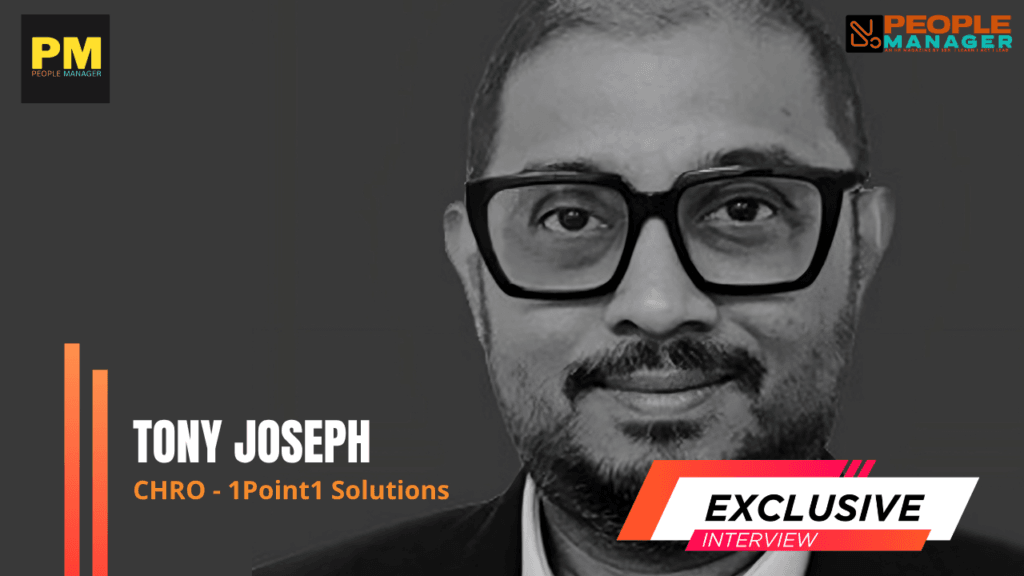
In this conversation with People Manager, Tony Joseph, CHRO of 1Point1 Solutions, shares how leadership accountability, “glocal” frameworks, and responsible technology use transform HR from policy enforcement to culture stewardship. His perspective reinforces a critical message for HR leaders across industries: the future of workforce effectiveness will be defined not by the scale of operations, but by how intelligently, empathetically, and consistently organizations embed people‑first principles into governance, leadership behavior, and employee experience systems.
Q. 1: Balancing Scale with Humanity: How organizations can maintain a people-first culture while scaling across diverse geographies, industries, and workforce models?
Ans.: As organisations expand across geographies and workforce models, the real challenge is not operational growth but preserving cultural integrity. In the BPM industry, where human interaction defines customer experience, scale must not come at the cost of empathy.
With nearly 6,000 employees across six Indian cities, 1Point1 Solutions has learned that while systems enable scale, leadership sustains culture. Processes and platforms can support expansion, but it is leadership behaviour that keeps organisational values alive as teams grow larger and more distributed.
Policies can standardise processes, but frontline managers build belonging, psychological safety, and motivation. Organisations must therefore invest in leadership development, equipping managers not just to drive productivity, but to mentor and support diverse teams. In a distributed workforce, the manager is often the closest representation of the organisation’s culture. Structured engagement calendars, town halls, skip-level conversations, and Open-Door culture to the leadership help maintain strong connections as the workforce grows. These practices ensure that scale does not weaken transparency or access to leadership.
Equally important is maintaining clarity of purpose. When organisations grow rapidly, employees across locations must still understand the larger mission they are contributing to. Regular communication around organisational goals, customer impact, and business outcomes helps reinforce this shared sense of purpose. Culture then becomes something employees experience daily rather than something that exists only in policy documents.
For organisations operating across multiple locations, consistency in leadership messaging also plays a critical role. When leaders across different cities communicate the same values and expectations, employees experience continuity regardless of where they work. This alignment ensures that growth strengthens rather than fragments organisational culture.
Q. 2: Global Consistency vs. Local Adaptation – Global Consistency vs. Local Adaptation: What strategies help HR leaders balance global workforce policies with local cultural, legal, and employee expectations?
Ans.: While workforce expectations differ across regions, global alignment remains essential. The solution lies in defining non-negotiables, fairness, inclusion, transparency, and meritocracy, while allowing flexibility in implementation.
At 1Point1 Solutions, these principles guide talent decisions across Mumbai, Bengaluru, Gurgaon, Indore, Chennai, and Pune. However, engagement formats and communication styles are adapted locally. This balance allows the organisation to maintain a common cultural framework while respecting regional nuances in communication and workplace practices.
With 44 to 46% women in our workforce and structured diversity metrics in place, we believe governance must be balanced with contextual sensitivity. Strong governance provides direction, while local leadership ensures relevance. The future of HR lies in “glocal” frameworks, globally aligned, locally responsive. Organisations that succeed in this balance create consistency in values without imposing rigidity in execution.
Q. 3: Technology as an Enabler: How can digital tools and AI be used to further strengthen employee experience without losing human touch?
Ans.: AI and digital tools provide deeper workforce insights, from predictive attrition analytics to personalised learning pathways. At 1Point1 Solutions, real-time diversity metrics and engagement indicators help identify skill gaps, retention risks, and training needs proactively.
However, technology must enhance, not replace the human experience. Data can indicate trends, but meaningful leadership conversations are still required to understand context and support employees effectively.
The most effective use of technology is when it frees leaders from administrative work and allows them to focus more on mentoring, development, and engagement.
Digital tools also enable greater transparency within organisations. Employees today expect clarity around career progression, skill development opportunities, and performance feedback. When technology platforms provide visibility into learning resources, internal mobility options, and development pathways, employees feel more empowered to take ownership of their careers.
At the same time, organisations must ensure that technology does not create distance between people. AI can provide insights, but the interpretation of those insights and the actions that follow must remain human-led. When technology and leadership complement each other, organisations are able to scale their people practices without losing empathy or trust.
Q. 4: 1Point1 Solutions: If you had to recommend one universal solution for building a people-first workforce globally, what would it be, and why?
Ans.: Leadership accountability is one of the universal levers for building a people-first organisation globally. When leaders are evaluated not only on revenue but also on engagement, retention, diversity, and talent development outcomes, priorities shift.
At 1Point1 Solutions, people metrics are integrated into leadership DNA, reinforcing that workforce outcomes are business outcomes. When engagement, learning, and retention are tracked alongside financial performance, people priorities naturally become part of strategic decision-making.
Q. 5: Voice of the Employee: How can organisations ensure employee feedback is not only collected but acted upon on a scale?
Ans.: Employee feedback is key for an organisation to grow, as employees are an integral part of it. Annual surveys alone are insufficient in dynamic industries like BPM. Continuous listening mechanisms, pulse surveys, focus groups, open forums, and digital helpdesks, must become embedded practices.
At 1Point1 Solutions, online helpdesk tracking, quarterly engagement initiatives and mentoring programmes foster dialogue. These channels ensure employees have multiple ways to share feedback or raise concerns. Crucially, feedback loops are closed with visible tracking mechanism, building trust and credibility. When employees see action following their input, participation and openness increase significantly.
Equally important is leadership visibility in the feedback process. When senior leaders acknowledge employee inputs and communicate the steps being taken in response, it strengthens organisational trust. Employees are more likely to share honest feedback when they believe their voices genuinely influence change.
Q. 6: Well-being at Scale: What practical frameworks can HR leaders adopt to embed employee well-being into global operations?
Ans.: Employee well-being is now a core productivity driver, not a side initiative. Well-being is a productivity driver, not a side initiative. In high-pressure environments, mental resilience, role clarity, and managerial support directly impact performance.
Structured mentoring, continuous learning, peer platforms, and manager sensitisation ensure accessible support systems across locations. Manager awareness is particularly important, as frontline leaders often recognise early signs of stress or disengagement. When well-being is embedded into leadership routines, it becomes operational, not optional.
Organisations must also recognise that well-being extends beyond physical health programmes. Career clarity, manageable workloads, and opportunities for growth all contribute to employee well-being. When employees feel supported in both their professional and personal development, they are more likely to remain engaged and productive.
Q. 7: Leadership Accountability: How should CHROs and business leaders be held accountable for sustaining a people-first approach across large, complex organisations?
Ans.: For CHROs, embedding accountability requires measurable frameworks. Diversity representation, internal mobility, engagement scores, learning hours, and retention data, must be reviewed alongside financial metrics Embedding people metrics into leadership dashboards ensures workforce priorities remain central to decision-making. When these indicators are reviewed regularly at leadership forums, people outcomes become business outcomes.
In addition, leadership performance evaluations must reflect these priorities. When business leaders are assessed not only on revenue and operational delivery but also on team engagement, talent development, and succession readiness, people-first leadership becomes embedded into everyday decision-making. This creates a culture where developing talent and strengthening teams are seen as critical leadership responsibilities rather than standalone HR initiatives.
We at 1Point1 work within the 4 walls of Business, People, Compliance and Technology. Balancing these pillars ensures organisational growth remains sustainable and responsible. This integrated approach ensures that workforce strategies are aligned with business priorities while maintaining strong governance and long-term organisational capability.
Q. 8: Culture Transmission: What are the most effective ways to transmit organisational culture across borders, remote teams, and hybrid workforces?
Ans.: In multi-location and hybrid organisations, culture is the core. Culture is reinforced through consistent leadership behaviour, storytelling, cross-location collaboration, and recognition of diverse success stories.
In hybrid environments, communication becomes foundational. Culture is reflected in daily actions, not presentations. Alignment across leadership layers ensures continuity across geographies. When leaders consistently demonstrate organisational values in everyday decisions and interactions, culture travels naturally across teams and locations.
Q. 9: Next Frontier: What emerging global workforce trends do you believe will redefine what “people-first” means in the next decade?
Ans.: The future of people-first will evolve into skills-first, trust-first, and inclusion-first models. While AI will automate processes, human capabilities, empathy, critical thinking, adaptability, will differentiate organisations.
Companies combining workforce analytics with inclusive leadership and reskilling investments will shape the future of work.
Another emerging shift will be the increasing focus on skills-based organisations. Rather than defining roles strictly through job titles, organisations will increasingly focus on capabilities and transferable skills. This approach enables greater workforce agility while also creating more opportunities for internal mobility and career growth.
Alongside skills-based models, organisations will also need to adapt to a workforce that increasingly values flexibility, transparency, and growth opportunities. Hybrid work has changed employee expectations, making trust and outcome-based leadership more important than traditional supervision. Employees today want greater visibility into career pathways, learning opportunities, and internal mobility options. Organisations that provide clear development frameworks, access to continuous learning, and exposure to cross-functional roles will be better positioned to retain talent and build long-term capability. At the same time, leadership teams must ensure that flexibility does not weaken team cohesion or organisational alignment. Regular communication, strong managerial engagement, and consistent leadership messaging will remain critical in maintaining both performance and culture. As the nature of work continues to evolve, companies that balance technological progress with strong people practices will be able to create workplaces that are both productive and sustainable.
At its core, people-first leadership is a philosophy. Organisations that sustain it at scale will not only grow, but they will also endure and at 1Point1 this philosophy continues to guide our everyday leadership approach. For further insights into the evolving workplace paradigm, visit