How a software engineer become an HCM architect to align enterprise solutions in Human-Centered HR Digitization?
I didn’t just shift from software to HR—I shifted from solving for systems to solving for people- HCM. Real transformation happens when technology doesn’t just optimize processes, but uplifts culture, capability, and connection.
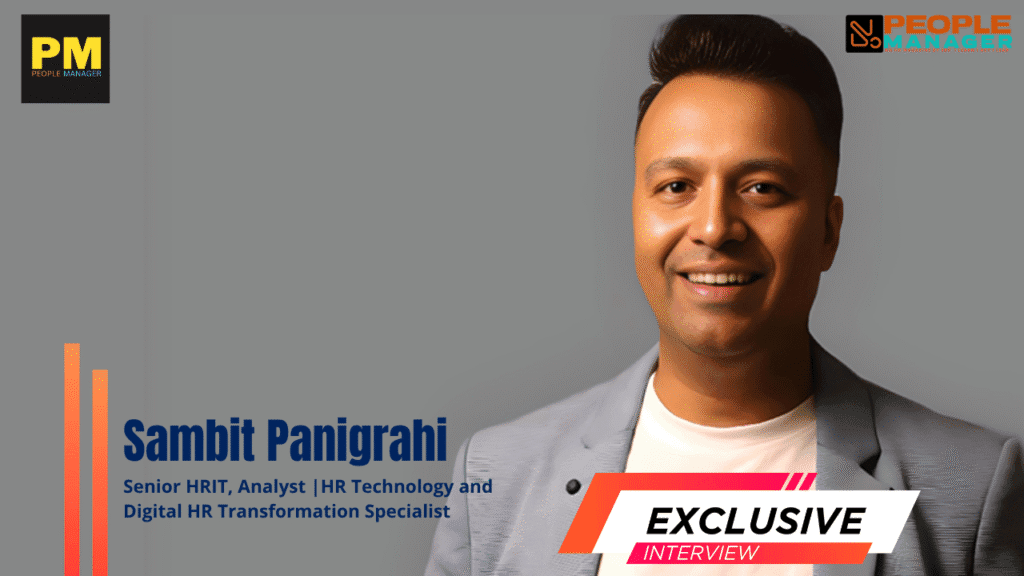
In today’s increasingly digital HR landscape, where agility and human-centered design are redefining enterprise success, leaders who blend empathy with innovation are setting a new standard. Sambit, a distinguished HR technology strategist and Hackathon Fellow, exemplifies this shift through a career anchored in purposeful transformation—from his foundational work at Wipro to leading high-impact digital rollouts at Deloitte and VITAS Healthcare. In an engaging conversation with Reet Verma, Editorial Director at People Manager, Sambit shares his playbook for scalable HR tech implementation, actionable analytics, and ethical AI deployment. This feature traces his evolution from software engineer to HCM architect, spotlighting how he leverages curiosity, collaboration, and system intelligence to drive business value and elevate the human experience in workplaces worldwide.
Sambit Panigrahi is a leading voice at the intersection of human resources and digital transformation, currently driving innovation at VITAS Healthcare—the largest hospice care provider in the United States. With a strong foundation in engineering and years of hands-on experience in enterprise HR technology and Digital HR Transformation, Sambit has led large-scale transformations impacting over 50,000 employees across healthcare, insurance, waste management and financial services. His expertise spans Oracle HCM Cloud, HR analytics, process automation, change management, and managing cross-functional teams across global geographies. He is widely recognized for developing practical, scalable solutions that improve employee experience while aligning with complex business goals.
Sambit has held pivotal roles at global firms like Deloitte Consulting and Wipro Technologies, where he led and supported complex HR transformations for Fortune 500 clients. His work is distinguished by the ability to turn workforce data into strategic insight—helping organizations make faster, smarter decisions that support long-term growth and employee engagement. He is also a published researcher, with peer-reviewed articles that draw from real-world industry data.
He remains passionate about sharing knowledge—whether through mentoring, writing, or collaborating across industries to shape the future of work.
“At the heart of it all,” he says, “I’m here to help organizations build smarter systems and more empowered people—because that’s where real transformation begins.”
Reet.: What first drew you to the crossroads of human resources and technology, and how did your early experiences at Wipro shape your passion for digital transformation in the workplace?
Sambit:: I joined Wipro as a fresh graduate after completing my Engineering degree, stepping into the world of enterprise technology with a lot of curiosity and desire to learn. In those early days, I navigated through intricate codes, algorithms, and systems, learning the ropes of software engineering and gaining valuable insights into Human Capital Management (HCM). A pivotal moment for me was during a major project where we helped migrate a client from an outdated, paper-based HR system to a PeopleSoft-based HCM ERP solution. Seeing how that digital transformation improved efficiency, empowered employees, and enabled data-driven decisions was truly eye-opening. That experience made me realize the real impact HR technology can have beyond just operations; it can reshape how organizations work. My time at Wipro became a powerful launchpad, sparking a long-term passion to use technology as a tool to solve HR challenges and drive meaningful, human-centred change. It also instilled in me a mindset of continuous learning and adaptability, qualities that continue to guide my journey in this space.
Reet : You’ve led some of the most complex HR tech implementations across industries. What core principles guide your approach to architecting enterprise-level HCM solutions?
Sambit:: At the core of my approach to architecting enterprise-level ERP solutions is a blend of curiosity, innovation, and a strong belief in empowerment. I’m someone who’s naturally curious. I’m always asking “why,” exploring new perspectives, and staying open to better ways of doing things. I believe we can’t solve modern problems with outdated thinking, so I’m always looking to bring creative, forward-thinking solutions to the table – solutions that are not only efficient but adaptable and people-centric. Whether it’s employees, recruiters, or leaders, I believe technology should enable people to succeed; not replace them. Designing solutions that improve operational efficiency is important, but what truly motivates me is the ability to enhance employee experiences and cultivate stronger, more resilient workplace cultures. There’s a unique satisfaction in seeing a well-crafted strategy come to life, in the seamless functioning of a complex solution, and in witnessing the positive difference it brings to the people who use it.
Reet : Can you walk us through the transformation you led at Vitas Healthcare—what were the biggest challenges, and what measurable outcomes did the organization see post-implementation?
Sambit:: Absolutely. Leading the digital HR transformation at VITAS Healthcare, the largest hospice care provider in the U.S., has been one of the most impactful experiences of my career so far. One of the biggest challenges was balancing the technical shift with the human element. We weren’t just replacing legacy systems; we were fundamentally changing how HR operated across the organization. That meant addressing resistance to change, streamlining fragmented workflows, and ensuring alignment with strict healthcare regulations. We achieved 99% payroll accuracy while cutting payroll processing time by 50%. We automated 80% of benefits administration, reducing open enrolment errors by 60% and lowering manual HR inquiries by 35%.
One of the key tools I personally developed during this transformation was the Recruiter Efficiency Scoreboard- a data-driven tool designed to track and improve recruitment performance across regions. In clinical hiring, we reduced time-to-hire by 27% and onboarding time by 30%, which directly impacted patient care delivery. By analysing this data over time, we were able to identify bottlenecks, coach recruiters more effectively, and align hiring practices with business needs. The result was a 19% reduction in early attrition and a noticeable improvement in hiring quality, particularly for critical clinical roles.
Reet: Your scientific research on ERP cost optimization offers tactical strategies for HR tech leaders. What prompted you to explore this academically, and how have your findings influenced real-world deployments?
Sambit:: Based on what I was seeing on the ground, I realized that many leaders were approaching digital transformation more as a checklist exercise rather than a strategic opportunity to rethink how HR could deliver value. I wanted to dig deeper into this disconnect and provide actionable strategies based on both data and experience. That led me to write the research article “Driving Organizational Cost Reduction through ERP Cloud Solutions: Strategies and Outcomes”, which was later got published in The American Journal of Engineering and Technology. The article highlights how leveraging automated tools, centralizing HR operations, enhancing reporting capabilities, and simplifying HR workflows can significantly reduce errors, save valuable time, and boost overall efficiency. These strategies enable organizations to be more agile in managing their workforce. Many companies are already using these approaches to lower operational costs, enhance workforce productivity, and transition toward a more digital, scalable, and future-ready HR model.
Reet: As a Fellow of the Hackathon Raptors community, you’re recognized among global innovators. How do hackathons and collaborative innovation ecosystems shape your thinking around HR analytics and automation?
Sambit:: Being a Fellow of the Hackathon Raptors community has been an incredible experience—it’s a space where innovation moves fast, and ideas evolve through real-time collaboration. In these high-pressure, idea-rich environments, you quickly learn the value of building solutions that are not only technically sound but also human-centric and scalable. I’ve worked alongside technology experts and innovators from leading companies, including FAANG and the Fortune 100, and that cross-pollination of ideas helps me spot emerging challenges and solutions that may not surface within a single organization. It’s also helped me reframe how I think about HR analytics, AI and automation—not just as a way to improve efficiency, but as a tool to predict behavior, personalize experiences, and support smarter decision-making in HR.
Reet: How do you balance the dual imperatives of efficiency and empathy when deploying AI and automation in people-related systems?
Sambit:: That’s a very important question, and honestly, it’s at the heart of every decision I make when working with AI and automation in HR systems. For me, the key is to never lose sight of the fact that we’re building systems for people—not just processes. I approach it by designing with both intent and insight. AI can automate repetitive tasks, flag risks, and generate insights faster than ever—but employees should know how decisions are made and feel that they are being treated with fairness and dignity. For example, in recruitment or performance management systems, I make sure there’s room for human judgment, personalization, and fairness checks—so decisions aren’t just fast, but also thoughtful and inclusive. When deployed responsibly, it can bring HR closer to people, not further away.
Reet: Reflecting on your time with Deloitte and other large-scale clients, what best practices have emerged for delivering scalable, employee-centric digital HR solutions in high-pressure environments?
Sambit:: At Deloitte I delivered large-scale digital HR solutions in high-pressure environments with the help of three core principles: clarity, adaptability, and empathy. First, clarity around the business goals and user needs is essential. I’ve learned to anchor every decision around one question: “How will this improve the employee experience while supporting the business outcome?”. Second, adaptability—especially through smart tools—is critical. For example, I engineered a set up extractor tool to extract the functional configurations, compare and manage migration across multiple environments during large Oracle HCM Cloud deployments. This tool streamlined configuration comparisons across development, testing, and production, helped reducing manual errors and increased traceability, and cuts down on manual work. More importantly, this tool has become a reusable asset. It is now leveraged across multiple ERP implementation, making it a model for scalable best practices in HCM Cloud delivery. Finally, empathy. In high-pressure rollouts, it’s not just about the system—it’s about how people experience the change. We focused heavily on change management, communication, and user-centric design to ensure adoption wasn’t just mandatory but meaningful.
Reet: What excites you most about the future of HR technology—are there specific trends, tools, or challenges you’re watching closely?
Sambit:: I am excited about transformative potential of virtual reality (VR). I believe VR is going to be a game-changer—especially in areas like onboarding, training, compliance, and employee engagement. Imagine immersing a new employee into a simulated first day on the job, no matter where they are in the world. It’s no longer a futuristic idea—it’s becoming a real, scalable solution. I see huge value in how it can standardize learning experiences, build confidence in high-risk roles, and make compliance training more interactive and effective especially in healthcare and other regulated industries.
That said, I’m also keeping a close eye on challenges: especially around data ethics, algorithmic bias, and change adoption. As systems become more powerful, it’s our responsibility as leaders to ensure they are fair, inclusive, and transparent. The future of HR tech is not just about tools—it’s about trust, strategy, and making work better for people.
Reet: In what ways do you mentor the next generation of HR tech professionals, and how important is community-driven learning in this evolving space?
Sambit:: No single person or organization has all the answers, so when we bring people together from different backgrounds- we create an environment where ideas grow faster, solutions are more inclusive, and the industry moves forward together. I actively engage with early-career professionals through hackathons, awards, and contests, where I not only judge and evaluate solutions but also share practical insights from real-world HR tech implementations. I also work with startups and aspiring founders as an advisor, helping them understand how to align technology with actual business and employee needs—because a good idea only succeeds if it solves a real problem.
Reet: If you had to craft a single line that captures your mission as an HR tech leader—your personal “tagline,” so to speak—what would it be, and why?
Sambit:: That’s an interesting question. “Engineering the people side of digital transformation”. Because I see my role not just as implementing systems, but as completely redesigning the way people connect, grow, and succeed at work in a fast-changing, digital world. Over the years, through complex ERP implementations, real-time analytics dashboards, and experimental projects, I’ve seen firsthand how future-ready HR can shape better business outcomes and better lives. This tagline is a reminder that the work I do is not just about technology—it’s about leading a mindset shift that prepares organizations and their people for what’s next. For further insights into the evolving workplace paradigm, visit

- New financial year to reshape salary structures for millions in India - March 26, 2026
- Sameer Inamdar On Agentic AI as a Catalyst for Measurable Learning Transfer - March 26, 2026
- Tony Joseph On How CHRO Build a People-First Workforce at Scale - March 23, 2026