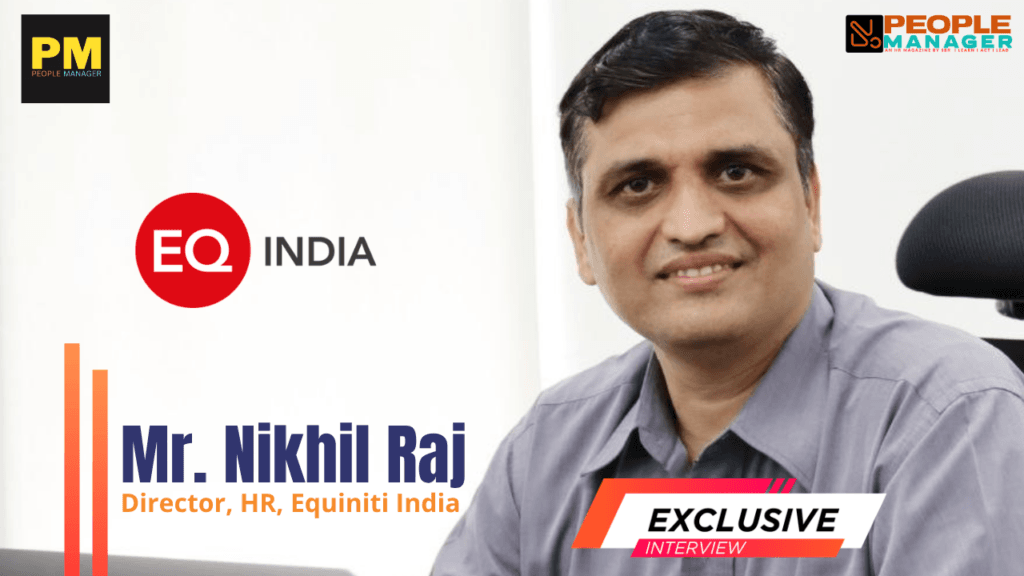
Nikhil Raj on How HR leaders can align HR transformation initiatives with business strategy?
In a multinational environment, HR leaders should follow the principle of global consistency with local relevance. Global HR transformation frameworks are important because they create common standards for culture, leadership, ethics, HR technology, workforce data, talent philosophy and employee experience. They help organisations scale efficiently and make consistent talent decisions across countries.
As organisations navigate an era defined by digital acceleration, artificial intelligence, skills disruption, evolving workforce expectations, hybrid work, and increasing pressure for agility and productivity, HR transformation is moving far beyond the modernisation of HR processes. The new mandate is strategic: to ensure that people, capability, culture, leadership, and workforce decisions directly enable business transformation and long-term competitiveness.
At the heart of this evolution is a fundamental shift in how HR defines its role. The question is no longer simply “What HR process should we improve?” but rather, “What business outcome are we trying to enable, and what people, skills, culture, leadership, and workforce changes are required to achieve it?” This business-outcome orientation positions HR as a strategic partner in growth, productivity, digital readiness, talent retention, risk management, and organisational agility.
For multinational organisations, the transformation agenda also requires a careful balance between global consistency and local relevance. Global frameworks can provide common standards for leadership, culture, technology, workforce data, talent philosophy, and employee experience. Yet markets such as India bring distinctive workforce demographics, cultural diversity, employee expectations, regulatory requirements, employment models, and regional realities. Successful transformation therefore depends on preserving global intent while adapting execution to local business and workforce needs.
Executive sponsorship is another critical dimension. HR transformation gains momentum when it is presented not as an HR cost or technology programme, but as a business investment with measurable returns. Strong business cases increasingly connect transformation initiatives to productivity, workforce-cost optimisation, attrition economics, hiring effectiveness, leadership readiness, automation savings, compliance risk, and growth. Co-creation with business leaders, phased implementation, pilots, governance, measurable milestones, and disciplined change management can turn transformation from an HR agenda into an enterprise priority.
Workforce analytics and predictive insights are further changing the way HR demonstrates value. Rather than relying predominantly on activity metrics such as hiring volumes or training hours, organisations are increasingly examining productivity, retention, skill readiness, internal mobility, leadership pipeline strength, absenteeism, engagement, workforce cost efficiency, and compliance risk. Predictive analytics can help identify emerging talent gaps, attrition risks, capability shortages, and future workforce requirements before they become business constraints.
Technology and AI are accelerating this shift. However, the strategic question is not how much technology HR can adopt, but where technology can create meaningful business value. Digital employee self-service, workforce analytics, AI-enabled talent acquisition, skills mapping, personalised learning, performance insights, and automation can improve scalability and decision-making. At the same time, data privacy, ethical AI, employee trust, and adoption must remain central to responsible transformation.
Transformation ultimately succeeds through people. HR must act as a change architect and adoption enabler, helping employees understand the purpose of change, preparing managers to lead transitions, identifying capability gaps, creating feedback mechanisms, and building change champions across the organisation. Equally, talent strategies must evolve to support future competitiveness through future-skills hiring, reskilling, leadership development, internal mobility, career progression, meaningful work, and stronger employee experiences.
Measurement is therefore becoming an essential discipline. A robust HR transformation scorecard connects people outcomes with enterprise outcomes, combining financial measures such as workforce-cost optimisation and automation savings with business indicators such as productivity, quality of hire, skill readiness, leadership pipeline strength, retention, internal mobility, engagement, and risk reduction. Before-and-after baselines, trend analysis, scenario modelling, and business-leader feedback can help demonstrate whether transformation is actually creating measurable organisational value.
In this exclusive conversation with People Manager, Nikhil Raj, Director, HR, Equiniti India, explores the changing role of HR in enterprise transformation and shares practical perspectives on aligning people strategy with business strategy. He discusses how HR leaders can secure executive sponsorship, balance global frameworks with India-specific realities, leverage workforce analytics and AI, manage resistance, strengthen talent strategies, measure transformation ROI, and future-proof the HR operating model.
Drawing on the Indian corporate context, Nikhil highlights a central principle for the next generation of HR leadership: global discipline must be combined with local flexibility, while people strategy must remain firmly connected to business outcomes. As organisations prepare for continued technological disruption and evolving workforce expectations, HR’s competitive advantage will increasingly depend on its ability to build future-ready capabilities, strengthen leadership, use data intelligently, and create an agile workforce capable of delivering sustainable business growth.
Q.: How can HR leaders ensure that transformation initiatives are not just HR-driven projects but are directly aligned with the organization’s overarching business strategy?
Answer: A practical way to do this is to ask: What business outcome are we trying to enable, and what people, skills, culture, leadership or workforce changes are needed to achieve it? If every HR initiative can answer this question clearly, it becomes business-aligned rather than HR-driven.
For example, If the priority is digital transformation, HR must focus on digital skills, change adoption, agile ways of working, reskilling and technology-led employee experience.
To make this alignment effective, HR leaders should follow five practical principles:
- Co-create HR priorities with business leaders
- Link every HR initiative to a business outcome
- Use data to guide decisions
- Prioritise transformation efforts
- Measure success in business language
Ultimately, the role of HR leaders is to ensure that people strategy sits at the centre of business strategy. HR transformation succeeds when it helps the organisation build the right skills, culture, leadership, structure and employee experience required to deliver business goals. In simple terms, HR should not ask, “What HR process do we want to improve?” but rather, “What business result do we need to enable, and how can our people strategy make that happen?”
Q.: In a multinational environment, how do you balance global HR transformation frameworks with the unique cultural and regulatory needs of local markets like India?
Answer: In a multinational environment, HR leaders should follow the principle of global consistency with local relevance. Global HR transformation frameworks are important because they create common standards for culture, leadership, ethics, HR technology, workforce data, talent philosophy and employee experience. They help organisations scale efficiently and make consistent talent decisions across countries.
However, local markets like India require thoughtful adaptation. India has a diverse workforce across regions, languages, cultures, generations and employment models. Employee expectations around career growth, manager engagement, flexibility, recognition and job security may differ from other markets. In addition, India has specific labour laws, payroll requirements, statutory benefits, contract labour rules, working-hour norms and state-level compliance variations.
Therefore, HR leaders must retain the global intent but customise local execution. The best approach is to standardise what must be common, localise what must be relevant, and involve local HR, legal and business teams early. This ensures transformation is compliant, practical, culturally appropriate and trusted by employees.
Q.: What approaches have proven most effective in securing executive leadership support for HR transformation programs that require significant investment and organizational change?
Answer: The most effective way to secure executive leadership support is to position HR transformation as a business investment, not an HR cost. Leaders are more likely to support initiatives when they see clear links to business outcomes such as growth, productivity, cost efficiency, digital readiness, talent retention, risk reduction and customer experience.
HR leaders should build a strong business case using data, financial impact and measurable ROI. Metrics such as attrition cost, hiring productivity, workforce cost optimisation, leadership readiness, automation savings and compliance risk help translate HR priorities into business language.
It is also important to involve the CXO’s and business heads early, so the programme is co-created and not seen as an HR-only agenda. A phased roadmap with pilots, quick wins, governance and clear milestones builds confidence. Finally, strong change management and executive sponsorship ensure accountability, adoption and sustained momentum.
Q.: How can HR leaders leverage workforce analytics and predictive insights to demonstrate the business impact of transformation initiatives?
Answer: HR leaders can leverage workforce analytics by connecting people data directly to business outcomes and using insights to guide transformation decisions. Instead of focusing only on activity-based HR metrics such as hiring numbers, training hours or employee participation, they should measure impact on productivity, retention, skill readiness, internal mobility, leadership pipeline strength, absenteeism, employee engagement, compliance risk and workforce cost efficiency. Predictive analytics can help identify future talent gaps, attrition risks, capability shortages and workforce demand before they affect business performance. This allows HR to move from reactive problem-solving to proactive business planning. Dashboards, trend analysis and scenario modelling can show where transformation is improving speed, reducing risk, optimising cost and enabling growth. When HR presents these insights in business language, it demonstrates that transformation initiatives are not just people programmes, but strategic levers that improve organisational performance, agility and long-term competitiveness.
Q.: With digital HR platforms and AI reshaping the function, how should HR leaders prioritize technology adoption to align with business growth objectives?
Answer: HR leaders should prioritise HR technology adoption based on clear business value, not trends. The focus should be on platforms and AI solutions that improve speed, scalability, productivity, employee/ customer experience and decision-making. Priority areas include digital employee self-service, workforce analytics, AI-enabled talent acquisition, skills mapping, learning personalisation, performance insights and automation of repetitive HR tasks. Technology should also support business growth by enabling faster hiring, future skills development, better workforce planning and stronger manager capability. Equally important, HR must ensure data privacy, ethical AI use, employee trust and change adoption. The goal is to use technology as a strategic enabler of growth.
Q.: What role does HR play in managing organizational resistance and ensuring smooth adoption of transformation initiatives across different levels of the workforce?
Answer: HR plays a critical role as a change architect and adoption enabler during transformation. HR must clearly communicate the purpose of change, link it to business priorities, and explain what it means for employees at different levels. Resistance can be managed by involving leaders early, preparing managers to handle questions, listening to employee concerns, and addressing capability gaps through training and support. HR should also identify change champions, create feedback channels, and ensure consistent messaging across geographies and teams. Smooth adoption happens when employees understand the “why,” trust the process, and feel supported through the transition.
Q.: How can HR transformation be designed to strengthen talent acquisition, retention, and development in ways that directly support business competitiveness?
Answer: HR transformation should strengthen talent by aligning acquisition, retention and development with the capabilities needed for business competitiveness. Talent acquisition must move beyond hiring for vacancies to hiring for future skills, scalability and strategic growth areas. Retention should focus on employee experience, career progression, manager effectiveness, flexibility, recognition and meaningful work. Development must prioritise reskilling, leadership readiness, internal mobility and building critical capabilities for digital and business transformation. Workforce analytics can help identify skill gaps, high-potential talent and attrition risks. When talent strategies are linked to business priorities, HR helps build a workforce that is agile, future-ready and competitive.
Q.: What metrics or frameworks should HR leaders use to measure the return on investment of transformation initiatives in terms of business outcomes?
Answer: HR leaders should measure HR transformation ROI using both financial and business-impact metrics. Key measures include productivity improvement, workforce cost optimisation, attrition reduction, hiring speed, quality of hire, internal mobility, skill readiness, leadership pipeline strength, employee engagement, absenteeism, compliance risk reduction and automation savings. A balanced scorecard framework works well, linking HR outcomes to business goals such as growth, efficiency, customer experience and risk management. ROI should also be assessed through before-and-after baselines, trend analysis and business leader feedback. The focus should be on proving how HR transformation improves performance, agility, scalability and long-term competitiveness.
Q.: How can HR leaders future-proof transformation strategies to remain relevant in an era of rapid technological disruption and evolving workforce expectations?
Answer: HR leaders can future-proof transformation strategies by building agility, continuous learning and adaptability into the HR operating model. Transformation should not be treated as a one-time project, but as an ongoing capability. HR must regularly assess emerging technologies, workforce expectations, skills trends and business priorities. Key focus areas include reskilling, digital capability building, leadership readiness, flexible workforce models, employee experience and ethical AI adoption. HR should use data and employee feedback to review what is working and adjust quickly. By creating a culture of learning, experimentation and responsiveness, HR can ensure transformation remains relevant and supports long-term business competitiveness.
Q.: From your perspective, what lessons can Indian HR leaders draw from global best practices in aligning HR transformation with enterprise strategy, and how can these be adapted to the Indian corporate landscape?
Answer: Indian HR leaders can draw key lessons from global best practices: align HR transformation with enterprise priorities, use data-driven workforce planning, build future skills, strengthen leadership pipelines, and design consistent employee experiences. However, these practices must be adapted to India’s unique context—diverse workforce demographics, regional differences, high talent competition, evolving labour regulations, and strong aspirations for career growth. Global frameworks should provide structure, governance and scalability, while local execution should reflect Indian cultural realities, compliance needs and employee expectations. The most effective approach is to combine global discipline with local flexibility, ensuring HR transformation drives business growth, inclusion and workforce readiness. For further insights into the evolving workplace paradigm, visit

- Shilpa Kalathur on Plugging the ‘Leaky Pipeline’ via Flexible Tech Ecosystems - October 10, 2026
- Ashish Gupta on Employee Benefits : Are they Ready for the “Sandwich Generation”? - October 10, 2026
- Zypp Electric Expands Employee Ownership with ₹11 Crore ESOP Allocation - October 2, 2026