

Book Review | Bend, Don’t Break: The Leadership Playbook Every HR Professional Needs for the AI Era
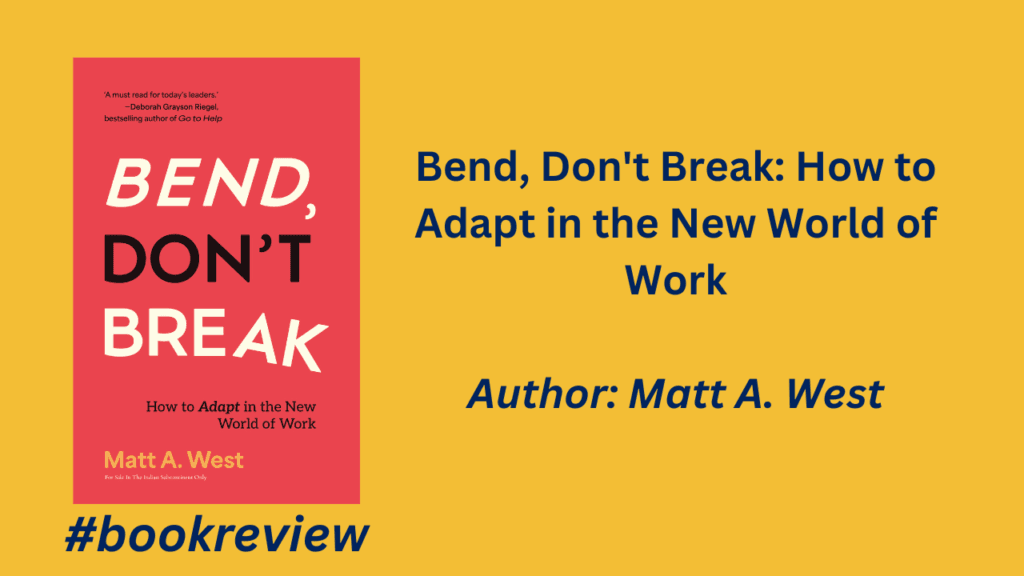
Book: Bend, Don’t Break: How to Adapt in the New World of Work
Author: Matt A. West
The Future of Work Will Not Reward the Most Experienced. It Will Reward the Most Adaptable.
Every decade produces a defining management idea.
The 1980s celebrated operational excellence.
The 1990s rewarded process reengineering.
The 2000s embraced digital transformation.
The 2010s prioritized employee experience and agile organizations.
The decade ahead will belong to adaptability.
Not adaptability as another leadership competency listed in a framework. Not adaptability as a fashionable business buzzword. But adaptability as the single capability that determines whether organizations—and the people within them—remain relevant amid continuous technological disruption.
Matt A. West’s Bend, Don’t Break is one of the most timely leadership books we have reviewed in recent years because it addresses the most pressing question facing every HR leader, CEO, business manager, and knowledge professional today:
How do we remain valuable when Artificial Intelligence is reshaping almost every aspect of work?
Unlike the flood of AI publications predicting which jobs will disappear, which technologies will dominate, or how organizations should automate, West chooses a far more important conversation.
His focus is not on machines.
His focus is on people.
And that makes all the difference.
A Human-Centered Blueprint for the AI Economy
The greatest strength of Bend, Don’t Break lies in what it refuses to become.
This is not another book about ChatGPT.
It is not another technology manual.
It is not another leadership manifesto filled with motivational clichés.
Instead, Matt West examines the psychological, behavioral, and organizational realities that emerge when change becomes permanent rather than occasional. From the opening chapter, he argues that today’s workplace is no longer defined by expertise alone. Professionals who built careers on deep specialization now find themselves competing in environments where knowledge has an increasingly shorter shelf life. What once guaranteed career success may quickly become obsolete if it cannot evolve.
For HR professionals, this observation could not be more relevant.
Organizations continue investing millions in upskilling initiatives, digital transformation programs, and AI implementation. Yet technology itself is rarely the greatest obstacle.
People are.
Not because employees resist innovation, but because they fear losing identity, relevance, and purpose.
West captures this human dimension exceptionally well.
The End of Expertise
Perhaps the book’s most provocative idea is the concept of “Frozen Expertise.”
For decades, organizations encouraged employees to become specialists.
Master your profession.
Develop expertise.
Become indispensable.
West challenges this traditional career philosophy by arguing that expertise, when protected too rigidly, eventually becomes a liability rather than an advantage. Professionals become trapped by the very knowledge that once made them successful because they begin defending existing competence instead of developing new capability.
This insight resonates deeply with today’s HR reality.
Across industries, organizations are redesigning jobs, introducing AI copilots, restructuring work, and redefining leadership expectations. Success increasingly belongs to employees willing to learn, unlearn, and relearn.
For HR leaders responsible for workforce transformation, this chapter alone justifies reading the book.
Adaptability Is Not a Skill—It Is a System
Leadership literature has long described adaptability as another competency to develop.
West challenges this assumption entirely.
His central argument is both simple and compelling:
Adaptability is not a skill. It is a system.
The framework he introduces consists of four integrated elements:
- Root to the Right Things
- Prune the Loops
- Cultivate the Core Five
- Grow in Beta
Rather than treating adaptability as an isolated behavior, the author presents it as an interconnected operating system governing how individuals respond to uncertainty, learn continuously, and sustain long-term performance.
For HR strategists, this systems perspective has significant implications.
Leadership development can no longer rely solely on competency models.
Future-ready organizations must deliberately build adaptive cultures.
The Emotional Side of Digital Transformation
One of the book’s most valuable contributions is its discussion of Identity Protection.
Digital transformation initiatives frequently assume that employees resist technology because they lack digital capability.
West offers a different explanation.
Employees often resist change because change threatens who they believe they are. AI is not simply automating tasks; it is challenging professional identity.
If someone has spent twenty years becoming “the expert,” automation can feel like personal displacement rather than technological progress. The fear extends beyond job security to questions of value, contribution, and purpose.
For HR leaders leading enterprise transformation, this insight is invaluable.
Successful change management begins with empathy, not software implementation.
Burnout, Not Resistance, Is the Real Risk
Another noteworthy strength is the author’s discussion of burnout.
Many organizations continue celebrating resilience while simultaneously increasing workloads, accelerating transformation programs, and expecting employees to adapt continuously without recovery.
West argues that adaptability without support inevitably leads to exhaustion. Sustainable performance requires psychological safety, meaningful recovery, and organizational systems that allow employees to stretch without breaking.
This message aligns closely with the evolving priorities of modern HR.
Employee wellbeing is no longer a wellness initiative.
It is a strategic capability.
Designed for Reflection, Not Just Reading
Unlike conventional leadership books, Bend, Don’t Break is intentionally practical.
Every chapter concludes with coaching exercises, reflection questions, adaptability assessments, and workplace challenges that encourage immediate application rather than passive consumption.
For Learning & Development professionals, executive coaches, and HR Business Partners, these exercises can easily be integrated into leadership workshops, coaching conversations, team development programs, and organizational learning initiatives.
The book becomes more than reading material.
It becomes a development toolkit.
Why This Book Matters to HR Leaders
The modern HR agenda has expanded dramatically.
Today’s HR leaders are expected to navigate AI adoption, workforce redesign, capability building, organizational agility, leadership succession, employee wellbeing, skills transformation, and cultural change—all simultaneously.
Technology will undoubtedly remain an important enabler.
However, organizational competitiveness will ultimately depend upon one question:
Can people adapt faster than change itself?
Matt West convincingly argues that the answer depends less on intelligence and more on mindset.
Organizations that cultivate curiosity, flexibility, resilience, continuous learning, and psychological safety will consistently outperform those relying solely on technical expertise.
At People Manager HR Magazine, we frequently evaluate leadership books through one simple lens:
Will this book still matter five years from now?
Bend, Don’t Break unquestionably will.
Its lessons extend beyond Artificial Intelligence.
They address the enduring human capability that every technological revolution demands—the willingness to evolve without losing one’s values, purpose, or humanity.
This is not simply another business book.
It is a thoughtful guide to remaining professionally relevant in an era where change has become permanent.
For CHROs, HR Directors, People Managers, Learning Leaders, Executive Coaches, and every professional preparing for the future of work, this book deserves a prominent place on the executive bookshelf.
As organizations continue investing in AI, perhaps the most important investment remains the one this book champions:
Building adaptable humans.
Because technology may transform work.
But adaptability will define those who lead it.
People Manager HR Magazine Rating
⭐⭐⭐⭐⭐ 5/5
Recommended For: CHROs • HR Leaders • CEOs • Learning & Development Professionals • HR Business Partners • Executive Coaches • Change Leaders • Future of Work Practitioners • Every Professional Navigating the AI Economy.
For further insights into the evolving workplace paradigm, visit

- Zypp Electric Expands Employee Ownership with ₹11 Crore ESOP Allocation - October 2, 2026
- DR. KOMAL BHANGU ON THE ENERGY CRISIS AT WORK: Why Employee Well-Being Begins with the Everyday Work? - October 1, 2026
- BDR Pharmaceuticals Appoints Niral Bhatt as Chief Human Resources Officer - September 26, 2026