
Global Hiring Outlook Remains Positive Amid Growing Economic Caution : Outlook Survey
The survey suggests that employers who successfully align workforce planning, skills development, and business objectives will be best positioned to compete in an evolving global labour market.
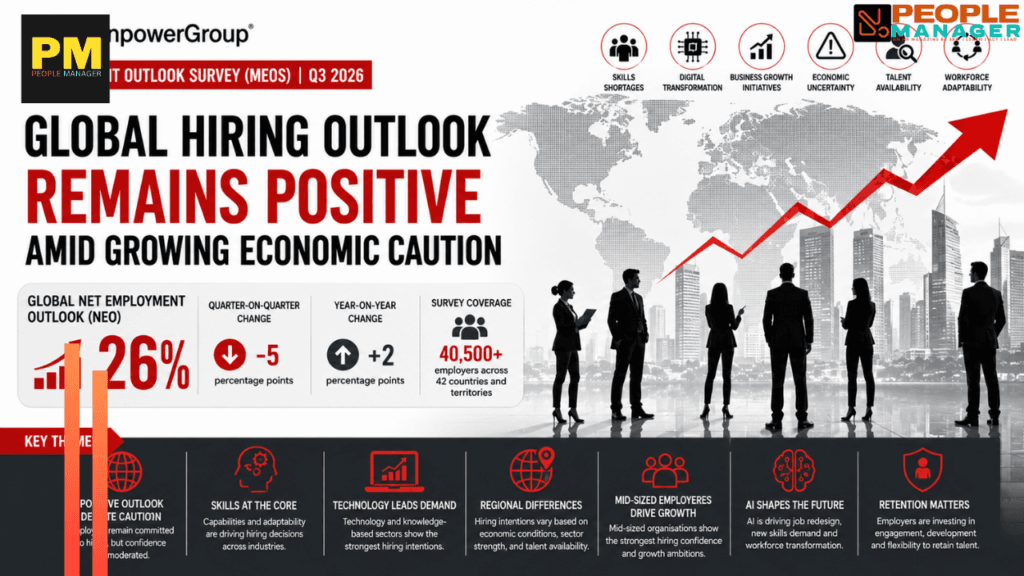
The ManpowerGroup Employment Outlook Survey (MEOS) for Q3 2026 reveals that employers worldwide continue to maintain positive hiring intentions despite increasing economic and geopolitical uncertainty. The survey, conducted among more than 40,500 employers across 42 countries and territories, highlights a resilient labour market supported by ongoing demand for skilled talent and strategic workforce planning.
Key Findings
Global Net Employment Outlook (NEO): 26%
Quarter-on-Quarter Change: -5 percentage points
Year-on-Year Change: +2 percentage points
Survey Coverage: 40,500+ employers across 42 countries and territories
Primary Hiring Drivers: Skills shortages, digital transformation, and business growth initiatives
Key Challenges: Economic uncertainty, talent availability, and workforce adaptability
1. Global Employment Outlook
Survey Findings
The global Net Employment Outlook (NEO) stands at 26% for Q3 2026, indicating that employers continue to anticipate workforce growth despite a moderation in hiring confidence compared with the previous quarter.
Although hiring expectations have softened, the outlook remains stronger than the same period last year, demonstrating continued resilience in global labour markets.
Key Insights
Employers remain focused on workforce expansion rather than workforce reduction.
Hiring strategies are becoming more targeted and selective.
Organisations are balancing growth ambitions with economic uncertainty.
Workforce planning is increasingly centred on flexibility and critical skills acquisition.
Implications for HR Leaders
HR professionals are expected to focus on strategic workforce planning, ensuring organisations can respond effectively to changing market conditions while maintaining access to critical talent.
2. Stability Rather Than Rapid Expansion
Survey Findings
Most surveyed markets reported lower hiring expectations compared with the previous quarter. However, employers continue to indicate positive recruitment intentions overall.
The decline in optimism appears to reflect caution rather than concerns about workforce reductions.
Key Trends
Increased emphasis on strategic hiring.
Greater focus on critical and hard-to-fill roles.
Reduced reliance on large-scale recruitment campaigns.
Growing adoption of flexible workforce models.
Employer Response
Organisations are increasingly implementing:
Skills-based workforce strategies
Internal mobility programmes
Contingent workforce solutions
Agile workforce planning frameworks
Survey Conclusion
Employers are prioritising workforce resilience and adaptability over aggressive expansion.
3. Skills Continue to Drive Hiring Decisions
Survey Findings
Skills remain the most significant factor influencing hiring decisions across industries.
Employers are increasingly prioritising capabilities and adaptability over traditional qualifications and job titles.
Key Drivers
Artificial intelligence adoption
Automation and digital transformation
Rapid technological change
Evolving business requirements
Emerging Workforce Strategies
Employers are responding through:
Upskilling programmes
Reskilling initiatives
Skills-based hiring practices
Expanded talent pools
HR Implications
Recruitment and talent management strategies are shifting toward identifying transferable skills and future potential rather than relying solely on conventional credentials.
4. Technology and Knowledge-Based Sectors Lead Hiring Demand
Survey Findings
The strongest hiring intentions continue to be concentrated in sectors requiring specialised expertise and advanced technical capabilities.
High-Growth Sectors
Technology
Demand remains strong for professionals in:
Artificial intelligence
Cybersecurity
Cloud computing
Data analytics
Automation technologies
Professional and Scientific Services
Employers continue to recruit highly skilled professionals to support innovation, transformation, and business growth.
Financial Services
Hiring activity remains positive as organisations adapt to:
Regulatory changes
Digital transformation
Evolving customer expectations
Healthcare
Healthcare employers continue to report sustained demand due to:
Demographic shifts
Workforce shortages
Increased service requirements
Survey Conclusion
Specialised skills continue to command a premium across multiple sectors, intensifying competition for qualified talent.
5. Regional Variations in Hiring Intentions
Survey Findings
Hiring expectations vary considerably across countries and regions.
While some markets continue to report strong recruitment plans, others are adopting a more cautious approach due to slower economic growth and external uncertainties.
Factors Influencing Regional Differences
Economic growth rates
Infrastructure investment
Availability of skilled labour
Industry composition
Technology sector strength
Stronger Hiring Markets Typically Feature
Expanding technology ecosystems
Growing service sectors
Active investment environments
High demand for skilled professionals
HR Considerations
Multinational organisations are increasingly tailoring workforce strategies to local labour market conditions rather than applying uniform global approaches.
6. Mid-Sized Employers Demonstrate Strongest Hiring Confidence
Survey Findings
Mid-sized organisations continue to report stronger hiring intentions than many larger employers.
Key Characteristics of Mid-Sized Employers
Greater organisational agility
Faster decision-making processes
Strong growth ambitions
Increased investment in talent acquisition
Comparative Trends
Mid-Sized Organisations
More likely to expand headcount
Focused on growth opportunities
Investing in workforce capabilities
Larger Organisations
Prioritising productivity improvements
Increasing operational efficiency
Implementing selective hiring strategies
Survey Conclusion
Mid-sized enterprises are playing an increasingly important role in driving employment growth across global markets.
7. Artificial Intelligence Reshapes Workforce Planning
Survey Findings
Artificial intelligence continues to influence workforce strategies and hiring decisions across industries.
Rather than replacing workers outright, AI is increasingly driving workforce transformation and job redesign.
Employer Priorities
Organisations are investing in:
AI implementation
Workforce training
Digital capability development
Change management initiatives
Emerging Skill Requirements
Demand is increasing for professionals who combine:
Technical Skills
AI literacy
Data analysis
Digital expertise
Technology management
Human Skills
Creativity
Collaboration
Critical thinking
Problem-solving
HR Implications
HR leaders are becoming central to organisational transformation efforts through workforce planning, skills assessment, and learning strategy development.
8. Talent Retention Remains a Strategic Priority
Survey Findings
Retention continues to be a major concern despite positive hiring intentions.
Employers recognise that replacing skilled workers remains costly and challenging, particularly in occupations experiencing persistent talent shortages.
Retention Strategies Identified
Organisations are strengthening:
Employee engagement programmes
Career development opportunities
Internal mobility initiatives
Learning and development investments
Flexible working arrangements
Key Objective
Employers are seeking to improve workforce stability while maintaining the ability to attract new talent.
HR Challenge
Balancing recruitment efforts with retention initiatives remains a critical workforce management priority.
Survey Conclusions
The Q3 2026 ManpowerGroup Employment Outlook Survey indicates that global hiring momentum remains positive despite a moderation in employer confidence.
Outlook for Employers and HR Leaders
As organisations navigate economic uncertainty and technological disruption, workforce strategies are increasingly focused on agility, skills development, and long-term talent sustainability.
The survey suggests that employers who successfully align workforce planning, skills development, and business objectives will be best positioned to compete in an evolving global labour market. For further insights into the evolving workplace paradigm, visit

- Shilpa Kalathur on Plugging the ‘Leaky Pipeline’ via Flexible Tech Ecosystems - October 10, 2026
- Ashish Gupta on Employee Benefits : Are they Ready for the “Sandwich Generation”? - October 10, 2026
- Zypp Electric Expands Employee Ownership with ₹11 Crore ESOP Allocation - October 2, 2026